
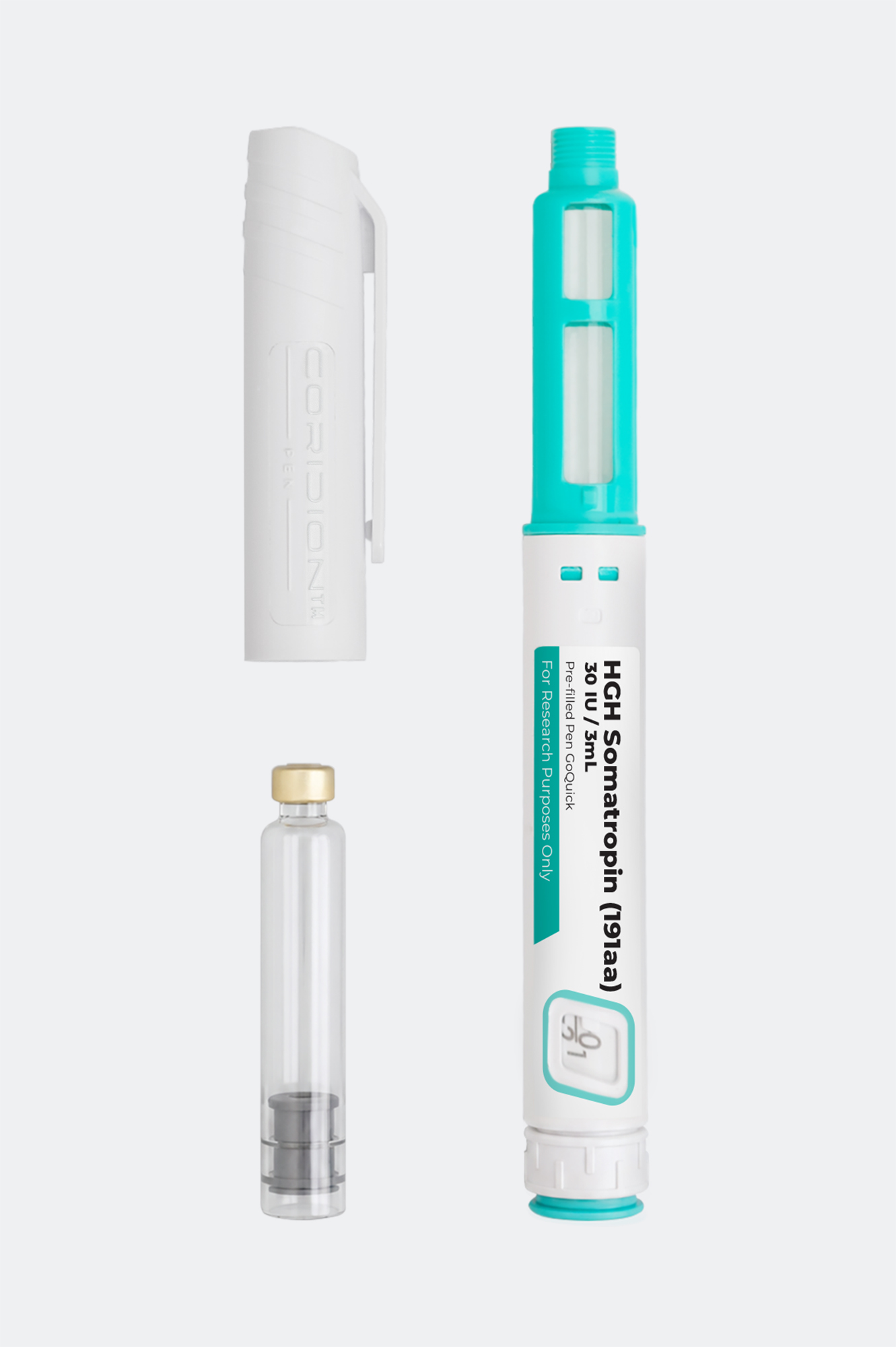
HGH Somatropin (191aa) – 30IU (3ml Pen)
Recombinant human growth hormone — the full 191-amino-acid sequence, and the reference standard against which every secretagogue in this category is measured. Research use only.
Growth Hormone Axis
IGF-1 Signalling
Body Composition
Description
HGH Somatropin (191aa) 30IU – Recombinant Human Growth Hormone Research
HGH Somatropin (191aa) is a recombinant form of human growth hormone containing the complete 191-amino-acid sequence of the naturally occurring pituitary hormone. Human growth hormone is a central regulator of tissue growth, protein metabolism, lipid utilisation and endocrine signalling.
Unlike growth hormone secretagogues, which stimulate the body’s production of growth hormone, somatropin acts directly on growth hormone receptors in target tissues.
This distinction makes somatropin an important reference compound in research involving the growth hormone axis, insulin-like growth factor-1 (IGF-1), skeletal muscle physiology and metabolic regulation.
The Coridion Sciences product is listed in a 30IU, 3ml pen format.
What Is HGH Somatropin 191aa?
Somatropin is a recombinant protein designed to reproduce the amino-acid sequence of endogenous human growth hormone.
The molecule contains 191 amino acids and has a molecular weight of approximately 22 kDa.
Human growth hormone is normally produced by somatotroph cells in the anterior pituitary gland. Its secretion is regulated by several physiological signals, including growth hormone-releasing hormone (GHRH), somatostatin and ghrelin-related pathways.
Somatropin provides researchers with a means of examining the biological activity of the hormone itself, rather than relying on compounds that indirectly stimulate its secretion.
Somatropin and Muscle Growth Research
Growth hormone participates in several biological mechanisms associated with skeletal muscle development, protein turnover and tissue metabolism.
Its activity is mediated through both direct growth hormone receptor signalling and indirect effects involving IGF-1.
Key areas of scientific investigation include:
- Protein synthesis: Research into growth hormone and IGF-1 signalling pathways involved in protein metabolism.
- Skeletal muscle physiology: Investigation of hormonal mechanisms associated with tissue growth and maintenance.
- Body composition: Studies examining relationships between growth hormone activity, lean body mass and adipose tissue.
- Tissue development: Research into cellular proliferation, differentiation and growth-related signalling.
- Metabolic regulation: Examination of lipid utilisation, glucose metabolism and insulin sensitivity.
- Endocrine signalling: Investigation of interactions between growth hormone, IGF-1 and other hormonal systems.
Although somatropin can influence body composition in certain clinical populations, increases in lean mass do not necessarily correspond to improvements in muscle strength or athletic performance.
Researchers investigating related biological mechanisms can also explore our collection of peptides associated with growth and performance research, including compounds studied for their effects on growth hormone secretion, muscle physiology and endocrine regulation.
How Does Somatropin Work?
Growth Hormone Receptor Activation
Somatropin binds to the growth hormone receptor (GHR), a member of the class I cytokine receptor family.
Receptor activation stimulates intracellular signalling pathways, including Janus kinase 2 (JAK2) and signal transducer and activator of transcription 5 (STAT5).
These pathways influence the expression of genes involved in growth, metabolism and cellular regulation.
IGF-1 Production and Signalling
One of the major downstream effects of growth hormone activity is stimulation of insulin-like growth factor-1 production.
IGF-1 is produced in the liver and other tissues and contributes to processes involving cellular growth, protein synthesis and skeletal development.
The growth hormone–IGF-1 axis is extensively investigated in endocrinology because of its central role in growth regulation and metabolic physiology.
Lipid Metabolism
Growth hormone influences lipid metabolism, including the mobilisation of stored triglycerides from adipose tissue.
Research has demonstrated that somatropin can increase lipolytic activity under certain physiological conditions.
These effects form part of the broader scientific literature examining growth hormone and body composition.
Glucose Metabolism and Insulin Sensitivity
Growth hormone also influences glucose regulation.
Its metabolic effects can oppose certain actions of insulin, potentially reducing insulin sensitivity and affecting blood glucose concentrations.
This relationship is particularly important in clinical and experimental investigations involving prolonged growth hormone exposure.
Scientific Research Applications
1. Growth Hormone Deficiency Research
Somatropin has an extensive clinical research history involving paediatric and adult growth hormone deficiency.
Studies have examined its effects on growth velocity, body composition, metabolism and quality-of-life outcomes in appropriately diagnosed patient populations.
2. Skeletal Muscle and Protein Metabolism
Growth hormone and IGF-1 participate in several biological pathways associated with protein synthesis and tissue regulation.
Research has examined how these mechanisms influence skeletal muscle physiology, particularly in growth hormone-deficient individuals.
However, these findings should not be extrapolated to claims of enhanced athletic performance in healthy individuals.
3. Body Composition and Adipose Tissue
Somatropin has been investigated for its effects on lean body mass, adipose tissue distribution and lipid metabolism.
Clinical responses vary according to the population studied, physiological status and research conditions.
4. Endocrine and IGF-1 Signalling
Somatropin is an important reference molecule in investigations examining growth hormone receptor activity and downstream IGF-1 production.
This research has contributed to understanding the relationship between hormonal signalling, tissue growth and metabolic regulation.
5. Ageing and Metabolic Research
Age-related changes in growth hormone secretion have prompted investigations into the relationship between the growth hormone axis, body composition and metabolic ageing.
However, somatropin is not established as a safe or effective anti-ageing treatment for otherwise healthy adults.
Somatropin vs Growth Hormone Secretagogues
Somatropin differs fundamentally from synthetic growth hormone-releasing peptides such as GHRP-2, GHRP-6 and Hexarelin.
Somatropin (HGH 191aa)
A recombinant form of human growth hormone that directly activates growth hormone receptors.
GHRP-2 and GHRP-6
Synthetic secretagogues that stimulate endogenous growth hormone secretion through the ghrelin receptor GHS-R1a.
Hexarelin
A growth hormone secretagogue investigated for pituitary signalling, receptor desensitisation and additional cardiovascular mechanisms.
CJC-1295 No DAC
A GHRH analogue investigated for its ability to stimulate endogenous growth hormone secretion through pituitary GHRH receptors.
These differences are important when comparing direct growth hormone receptor activation with mechanisms that regulate endogenous hormone release.
HGH Somatropin (191aa) 30IU Product Specifications
- Product: HGH Somatropin (191aa)
- Compound: Recombinant human growth hormone
- Quantity: 30IU
- Format: 3ml pen
- Molecular structure: 191 amino acids
- Approximate molecular weight: 22 kDa
- Primary receptor: Growth hormone receptor (GHR)
- Principal signalling pathways: JAK2/STAT5 and IGF-1-related signalling
- Research areas: Endocrinology, tissue growth, protein metabolism, lipid regulation and glucose metabolism
HGH and Endocrine Research at Coridion Sciences
Coridion Sciences maintains a catalogue of research compounds covering growth hormone biology, endocrine regulation, metabolic pathways and tissue physiology.
Somatropin 191aa is distinct from the company’s growth hormone secretagogues because it represents the complete human growth hormone sequence, rather than a compound designed to stimulate pituitary hormone release.
Important regulatory information: Somatropin is a prescription-regulated biological medicine with established clinical applications and significant contraindications. A research-use designation does not exempt its supply from applicable medicines legislation. It must not be presented as approved for unsupervised human use, bodybuilding, anti-ageing or athletic performance enhancement.
Mechanisms of Action
Somatropin is identical in sequence to endogenous pituitary growth hormone. Research describes binding to the growth hormone receptor, a cytokine receptor superfamily member, producing receptor dimerisation and JAK2/STAT5 pathway activation. Effects are documented as both direct — lipolysis in adipose tissue, glucose handling changes in muscle and liver — and indirect, mediated by hepatic IGF-1 production driving anabolic and growth-related signalling. The literature extensively characterises the counter-regulatory relationship with insulin sensitivity.
Research Status & Findings
An exceptionally large clinical and mechanistic literature spanning endocrinology, metabolism, body composition and ageing research, with full regulatory documentation available.
Clinical endocrinology
Extensive trial data in growth hormone deficiency across age groups.
Body composition
Research on lean mass and adipose tissue distribution endpoints.
Metabolic effects
Well-documented work on insulin sensitivity and glucose handling.
Receptor signalling
Detailed characterisation of JAK2/STAT5 pathway activation.
Regulatory and anti-doping
A prescription medicine in most jurisdictions and listed by anti-doping authorities.
*For research purposes only – not for human consumption*

As Seen In The Press
Peptides can affect the way the body functions at a cellular level.

Our 3 Step System
Pre-filled Cartridges
Engineered for absolute accuracy and ease. Our pre-blended pens make precise dosing completely seamless in just three quick steps.
Step 1 - Remove the Pre-mixed pen from the box
Step 2 - Secure the needle tip
Step 3 - Twist to set the required dose

Blends
Blends

Sermorelin + GHRP-6 – 5mg / 5mg (3ml Pen)
Sermorelin + GHRP-6 5mg/5mg combines a 29-amino-acid GHRH analogue with a synthetic ghrelin receptor agonist. Investigated for complementary growth hormone signalling pathways, pituitary hormone. Research use only.
£95.00
Blends
Sermorelin + GHRP-2 – 5mg / 5mg (3ml Pen)
Sermorelin + GHRP-2 5mg/5mg combines a 29-amino-acid GHRH analogue with a synthetic growth hormone secretagogue. Investigated for complementary pituitary signalling, ghrelin receptor activation and. Research use only.
£99.00
Blends
Longevity Blend (Glutathione / NAD+ / Resveratrol) – 500mg / 100mg / 500mg (3ml Pen)
Three pillars of cellular ageing research in one pen. Pairs antioxidant defence, NAD+ coenzyme power, and sirtuin-modulating activity. Research use only. Research use only.
£129.00
Blends
Vitality Blend (Glutathione / NMN / Resveratrol) – 500mg / 500mg / 500mg (3ml Pen)
The NAD+ precursor evolution. Swaps direct NAD+ for NMN — the biosynthetic precursor the cell uses via the salvage pathway. Research use only. Research use only.
£129.00
Blends
SS-31 + MOTS-c – 10mg / 10mg (3ml Pen)
Two mitochondrial compounds acting on different layers of the same biology — membrane structure and mitokine signalling. Research use only. Research use only.
£139.00
Blends
SS-31 + MOTS-c + NAD+ – 10mg / 10mg / 200mg (3ml Pen)
The flagship triple combination of mitochondrial research. SS-31, MOTS-c and NAD+ each act on a different layer of cellular energy biology — structure, signal. Research use only.
£159.00
Blends
KLOW Blend Peptide – BPC-157, TB-500, KPV & GHK-Cu (3ml Pen)
KLOW Blend Peptide combines BPC-157 10mg, TB-500 10mg, KPV 10mg and GHK-Cu 50mg in a four-component research formulation. The blend brings together compounds studied. Research use only.
£105.00
Blends
CJC-1295 (No DAC) + Ipamorelin + GHRP-2 – 3mg / 3mg / 3mg (3ml Pen)
A three-component preparation pairing a GHRH analogue with both a selective and a higher-potency ghrelin agonist. Research use only. Research use only.
£95.00
Blends
Glow Blend Peptide – BPC-157, TB-500 & GHK-Cu (3ml Pen)
Glow Blend Peptide combines GHK-Cu 50mg, BPC-157 10mg and TB-500 10mg in a three-component research formulation. Its ingredients have been investigated individually for extracellular. Research use only.
£95.00


