
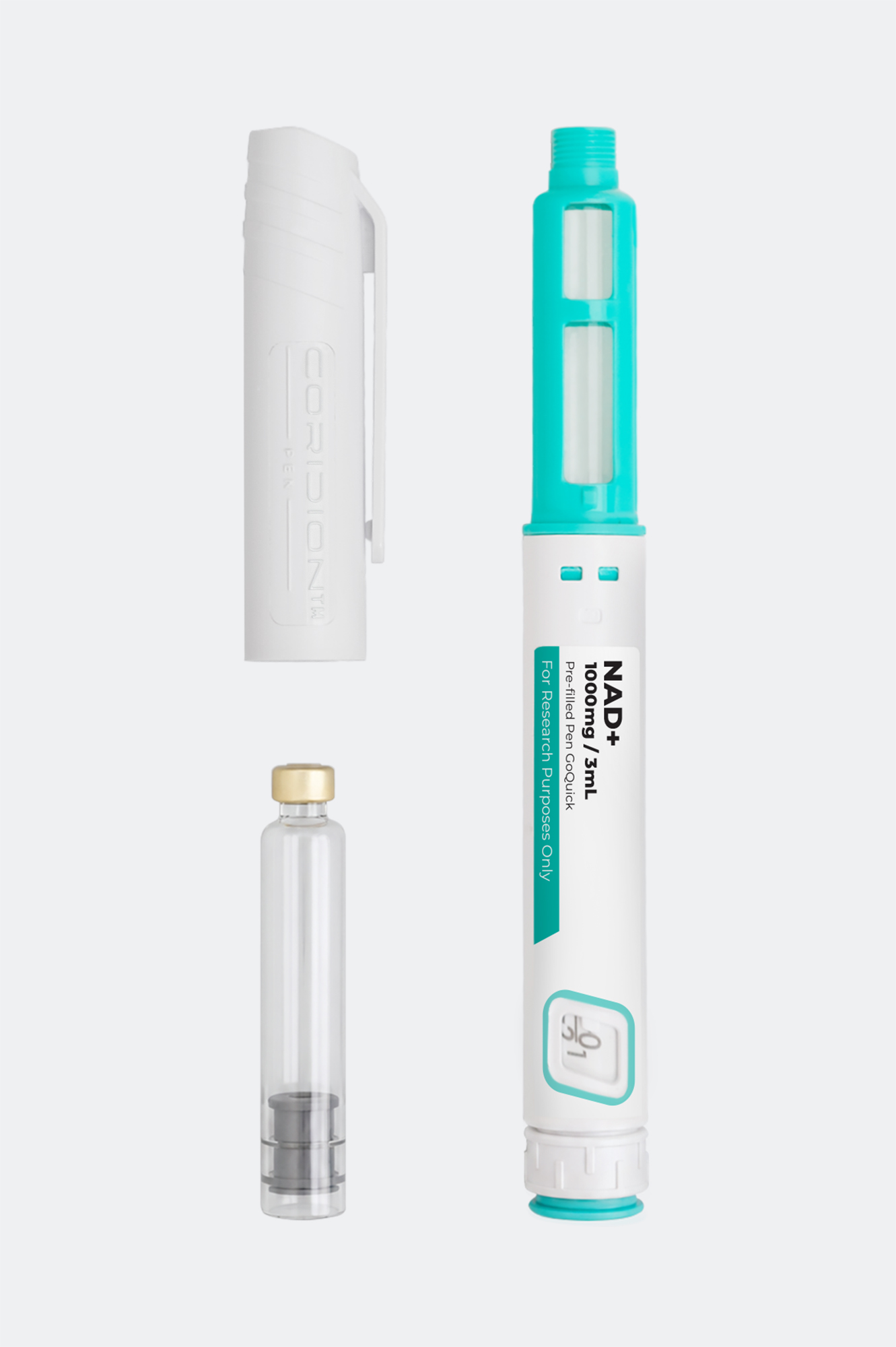
NAD+ (Nicotinamide Adenine Dinucleotide) – Cellular Energy and Longevity Research
The central redox coenzyme of cellular metabolism, and the molecule around which the entire modern longevity research field is organised. Research use only.
NAD+ Pathway
Cellular Energy
Sirtuin Activity
Description
NAD+ (nicotinamide adenine dinucleotide) is an essential coenzyme involved in cellular energy metabolism, mitochondrial function, redox reactions and multiple biochemical signalling pathways.
Present in virtually every living cell, NAD+ plays a fundamental role in the transfer of electrons during metabolic reactions that contribute to cellular energy production.
Beyond its established function in metabolism, NAD+ is also consumed by enzymes involved in DNA damage responses, protein modification and cellular signalling.
These include sirtuins, poly(ADP-ribose) polymerases (PARPs) and CD38-related enzymes.
NAD+ has become a major focus of scientific research into cellular ageing because its concentration and metabolism can change with age, physiological stress and disease.
However, the benefits of externally administered NAD+ remain substantially less established than its essential biological functions.
Coridion Sciences supplies NAD+ in a 3ml pen format for scientific and laboratory research.
What Is NAD+?
NAD+ stands for nicotinamide adenine dinucleotide.
It is a naturally occurring coenzyme formed from two nucleotides joined through their phosphate groups.
One nucleotide contains an adenine base, while the other contains nicotinamide.
NAD exists in two principal redox states:
NAD+ – Oxidised form
The oxidised form accepts electrons during numerous metabolic reactions.
NADH – Reduced form
The reduced form carries electrons that can subsequently participate in cellular energy production.
The conversion between NAD+ and NADH is fundamental to cellular metabolism.
Unlike signalling peptides, NAD+ is not made from a short amino-acid chain and does not act primarily through a conventional peptide receptor.
Its activity arises from its role as a redox cofactor and substrate for several enzyme families.
NAD+ and Cellular Energy Metabolism
Cellular energy production involves a network of interconnected biochemical reactions.
NAD+ contributes to several of these processes through reversible electron transfer.
Glycolysis
Glycolysis is the metabolic pathway through which glucose is converted into pyruvate.
During this process, NAD+ accepts electrons and is converted into NADH.
The continued availability of NAD+ is essential for maintaining glycolytic activity.
The Citric Acid Cycle
The citric acid cycle, also called the tricarboxylic acid or Krebs cycle, operates within the mitochondrial matrix.
It contains several enzyme reactions that transfer electrons to NAD+, producing NADH.
These electron carriers subsequently contribute to mitochondrial energy metabolism.
Oxidative Phosphorylation
Oxidative phosphorylation occurs at the inner mitochondrial membrane.
NADH contributes electrons to the mitochondrial electron transport chain through Complex I.
The resulting electrochemical gradient supports ATP synthesis.
NAD+ itself is not ATP and should not be described as a direct energy supplement.
Rather, it participates in the biochemical reactions that help cells generate and regulate energy.
Researchers investigating related processes can explore our cellular energy and mitochondrial research collection.
How Does NAD+ Work?
NAD+ has two broad biological functions: acting as a coenzyme in oxidation–reduction reactions and serving as a substrate for enzymes involved in cellular regulation.
NAD+ and Sirtuin Activity
Sirtuins are a family of NAD+-dependent enzymes involved in protein deacetylation and other cellular regulatory reactions.
Mammals possess seven sirtuin proteins, commonly designated SIRT1 through SIRT7.
Different sirtuins operate in distinct cellular locations, including the nucleus, cytoplasm and mitochondria.
Research has investigated their involvement in:
- Metabolic gene regulation
- Cellular stress responses
- Mitochondrial-associated signalling
- Protein modification
- DNA maintenance
- Ageing-related biological processes
Sirtuin activity depends on NAD+ availability, making NAD metabolism relevant to research into these enzymes.
However, increasing NAD+ availability does not automatically establish improved sirtuin function or anti-ageing benefits in humans.
NAD+ and DNA Repair
DNA is exposed to damage from normal cellular metabolism and environmental factors.
Cells maintain several biological systems for detecting and responding to DNA damage.
Poly(ADP-ribose) polymerases, particularly PARP1, participate in certain DNA damage responses.
PARP enzymes consume NAD+ when producing ADP-ribose-based modifications involved in cellular signalling.
This creates an important connection between NAD+ availability and DNA repair-associated biology.
However, NAD+ is not itself a DNA repair enzyme, and externally supplying it has not been proven to improve DNA repair outcomes in humans.
CD38 and NAD+ Consumption
CD38 is an enzyme involved in NAD+ metabolism and the production of signalling molecules.
Its activity has attracted interest in ageing research because certain experimental studies have identified changes in CD38 expression and NAD+ consumption with age.
Animal studies suggest that CD38-associated activity can contribute to altered NAD+ levels in some tissues.
However, ageing-related changes vary across tissues and populations, and CD38 is not the sole determinant of cellular NAD+ availability.
Mitochondrial Signalling
Mitochondria depend on NAD+/NADH redox reactions to support oxidative metabolism.
NAD+ metabolism also interacts with regulatory systems involved in mitochondrial physiology.
These relationships have prompted investigations into whether changes in NAD+ availability influence mitochondrial responses to cellular stress.
However, systemic NAD+ administration does not guarantee increased NAD+ concentrations inside mitochondria.
Intracellular transport, compartment-specific metabolism and enzyme activity must all be considered.
NAD+ and the Biology of Ageing
NAD+ has become an important subject in longevity research because several studies have reported age-associated changes in NAD+ metabolism.
Experiments in animals and analyses of human tissues have identified reductions in NAD+ concentrations in some tissues and physiological conditions.
However, the extent of age-related decline is not uniform.
It can vary according to tissue type, metabolic state, measurement technique and the population studied.
The relationship between NAD+ and ageing is also complex because NAD+ participates in many fundamental biochemical processes.
Changes in cellular NAD+ may reflect altered synthesis, consumption, degradation or redistribution between cellular compartments.
Researchers continue to investigate whether these changes contribute directly to age-related dysfunction or are consequences of other biological processes.
NAD+ and Cellular Senescence
Cellular senescence is associated with changes in cell-cycle regulation, stress responses and cellular metabolism.
NAD+ metabolism has been investigated in relation to senescence-associated signalling.
However, the evidence does not establish NAD+ as a senolytic compound or demonstrate that externally administered NAD+ reverses cellular ageing.
NAD+ and Mitochondrial Ageing
Ageing-associated mitochondrial changes can involve altered metabolism, oxidative stress responses and cellular signalling.
Researchers have investigated whether changes in NAD+ availability contribute to these processes.
The findings are biologically relevant but do not establish that a particular NAD+ formulation improves mitochondrial function or extends lifespan in humans.
Explore our longevity and cellular ageing research compounds for related scientific topics.
NAD+ Biosynthesis and the Salvage Pathway
NAD+ is continuously synthesised, consumed and recycled within cells.
Mammalian cells produce NAD+ through several pathways.
The Nicotinamide Salvage Pathway
One major route involves recycling nicotinamide.
Nicotinamide is converted into nicotinamide mononucleotide (NMN) by the enzyme nicotinamide phosphoribosyltransferase (NAMPT).
NMN is then converted into NAD+ by nicotinamide mononucleotide adenylyltransferase (NMNAT) enzymes.
This pathway is important for maintaining NAD+ availability in many cell types.
Nicotinamide Riboside Pathway
Nicotinamide riboside (NR) is another NAD+ precursor.
It can be converted into NMN through nicotinamide riboside kinase enzymes before entering the NAD+ synthesis pathway.
NR has been investigated in multiple human studies measuring changes in blood NAD-related metabolites.
De Novo NAD+ Synthesis
Cells can also synthesise NAD+ through biochemical pathways originating from tryptophan.
This is distinct from recycling pre-existing nicotinamide through the salvage pathway.
The Preiss–Handler Pathway
Nicotinic acid can contribute to NAD+ production through the Preiss–Handler pathway.
Together, these pathways demonstrate that NAD+ metabolism is maintained by a network of precursor availability, enzyme activity and cellular demand.
Direct NAD+ Compared with NAD+ Precursors
An important research question concerns the difference between providing NAD+ itself and supplying compounds that cells can convert into NAD+.
NAD+ – The Established Coenzyme
NAD+ is the active coenzyme involved in cellular redox metabolism and enzyme-mediated signalling.
However, supplying NAD+ outside a cell does not necessarily ensure that intact NAD+ enters the cytoplasm or mitochondrial compartments.
Extracellular NAD+ can undergo enzymatic degradation and participate in signalling pathways.
Its cellular availability depends on the biological system and experimental conditions.
NMN – Nicotinamide Mononucleotide
NMN (Nicotinamide Mononucleotide) is an NAD+ precursor converted into NAD+ through NMNAT-mediated reactions.
Research has investigated NMN in laboratory models and human studies, including its effects on NAD-related metabolites.
However, the extent to which NMN enters cells intact can vary with the experimental model, and transporter-related mechanisms remain under investigation.
NR – Nicotinamide Riboside
NR (Nicotinamide Riboside) is a nucleoside precursor converted into NMN before NAD+ synthesis.
Its published research includes human pharmacokinetic and clinical studies.
Some trials have reported increased blood NAD-related metabolites following NR administration, although functional clinical outcomes have been inconsistent.
5-Amino-1MQ – NNMT Research
5-Amino-1MQ is an experimental inhibitor of nicotinamide N-methyltransferase (NNMT).
Its mechanism differs from NAD+ supplementation because it investigates how inhibiting nicotinamide methylation may influence NAD+ salvage-related metabolism.
5-Amino-1MQ is also a small molecule rather than a peptide.
These compounds should not be treated as interchangeable simply because they participate in connected metabolic pathways.
Scientific Research Applications
1. Redox Biology
NAD+ is fundamental to investigations into electron-transfer reactions and cellular energy production.
Its role in redox chemistry is one of the best-established areas of modern biochemistry.
2. Mitochondrial Metabolism
NAD+/NADH interactions are central to mitochondrial energy metabolism.
Research examines how changes in these ratios and concentrations influence cellular metabolic processes.
3. Sirtuin Enzyme Research
NAD+ is a necessary substrate for sirtuin activity.
Laboratory investigations examine its relationship with protein modifications, stress-associated signalling and metabolic gene regulation.
4. DNA Damage Responses
PARP-dependent pathways consume NAD+ during certain DNA damage responses.
This makes NAD+ metabolism relevant to studies investigating cellular responses to genomic stress.
5. Cellular Ageing
Research continues to investigate changes in NAD+ concentrations, enzyme activity and precursor metabolism across ageing-related biological models.
However, NAD+ is not an established treatment for ageing.
6. Extracellular NAD+ Metabolism
Externally supplied NAD+ is relevant to research examining nucleotide degradation, extracellular signalling and cellular transport.
Its behaviour outside the cell is a separate research question from the established intracellular functions of NAD+.
NAD+ Compared with Related Cellular Energy Research Formulations
Standalone NAD+
The individual coenzyme is most directly relevant to research focused on NAD+ metabolism, redox reactions, enzyme consumption and extracellular nucleotide biology.
Longevity Blend – NAD+, Glutathione and Resveratrol
The Longevity Blend research formulation combines NAD+ with glutathione and resveratrol.
Its components have different biochemical research backgrounds involving redox balance and cellular signalling.
Evidence for standalone NAD+ cannot automatically establish the properties of the complete formulation.
SS-31 + MOTS-c + NAD+
This three-component blend combines NAD+ with compounds investigated for mitochondrial membrane biology and mitochondrial-derived signalling.
The formulation introduces additional questions about molecular compatibility and component-specific research mechanisms.
MOTS-c – Mitochondrial-Derived Peptide
MOTS-c is a mitochondrially encoded peptide investigated for AMPK-associated metabolic signalling and cellular stress responses.
Unlike NAD+, MOTS-c is a peptide with a distinct molecular origin and mechanism.
NAD+ Product Specifications
- Product name: NAD+ (Nicotinamide Adenine Dinucleotide)
- Format: 3ml pen
- Classification: Naturally occurring redox coenzyme
- Chemical form: Oxidised nicotinamide adenine dinucleotide
- Reduced counterpart: NADH
- Primary biological role: Electron transfer in cellular metabolism
- Key research pathways: Glycolysis, citric acid cycle and oxidative phosphorylation
- Enzyme-associated research: Sirtuins, PARPs and CD38
- Additional research areas: Cellular ageing, DNA damage responses and mitochondrial physiology
- Product quantity: Depends on the selected variation
- Evidence status: Extensive established biochemical evidence; formulation-specific human benefits have not been demonstrated
NAD+ Research at Coridion Sciences
Coridion Sciences supplies specialist research compounds and experimental formulations for investigations involving cellular energy, metabolism and ageing-associated biological pathways.
Standalone NAD+ forms part of the company’s cellular energy research collection, alongside precursors, mitochondrial-derived peptides and multi-component formulations.
For research specifically examining NAD+ redox chemistry and enzyme-associated signalling, the individual coenzyme should be distinguished from blends and upstream metabolic precursors.
Research Use Only: This NAD+ formulation is supplied for scientific and laboratory investigation. It is not established as an approved medicine for fatigue, anti-ageing treatment, cognitive enhancement or other therapeutic applications. Its formulation-specific safety and efficacy for human administration have not been demonstrated.
Mechanisms of Action
NAD+ functions as an electron carrier in redox reactions central to glycolysis, the citric acid cycle and oxidative phosphorylation. Beyond its redox role, research describes NAD+ as a consumed substrate for three enzyme families: sirtuins, which mediate deacetylation reactions linked to metabolic and stress-response gene regulation; PARPs, involved in DNA damage repair; and CD38, a principal consumer whose activity is reported to increase with age. Direct extracellular NAD+ availability and cellular uptake remain actively debated in the literature.
Research Status & Findings
An enormous foundational biochemical literature, with the intervention research — how best to raise tissue levels, and whether doing so produces measurable outcomes — considerably less settled than the underlying biology.
Age-related decline
Well-replicated findings of falling tissue NAD+ concentration across species.
Sirtuin research
Extensive work on NAD+-dependent deacetylase activity and metabolic gene regulation.
DNA repair
Studies on PARP activity and NAD+ consumption during genomic stress.
CD38 research
Investigation of the principal NAD+-consuming enzyme and its age-related increase.
Bioavailability debate
Ongoing research on direct NAD+ uptake versus precursor-based approaches.
*For research purposes only – not for human consumption*

As Seen In The Press
Peptides can affect the way the body functions at a cellular level.

Our 3 Step System
Pre-filled Cartridges
Engineered for absolute accuracy and ease. Our pre-blended pens make precise dosing completely seamless in just three quick steps.
Step 1 - Remove the Pre-mixed pen from the box
Step 2 - Secure the needle tip
Step 3 - Twist to set the required dose

Blends
Blends

Sermorelin + GHRP-6 – 5mg / 5mg (3ml Pen)
Sermorelin + GHRP-6 5mg/5mg combines a 29-amino-acid GHRH analogue with a synthetic ghrelin receptor agonist. Investigated for complementary growth hormone signalling pathways, pituitary hormone. Research use only.
£95.00
Blends
Sermorelin + GHRP-2 – 5mg / 5mg (3ml Pen)
Sermorelin + GHRP-2 5mg/5mg combines a 29-amino-acid GHRH analogue with a synthetic growth hormone secretagogue. Investigated for complementary pituitary signalling, ghrelin receptor activation and. Research use only.
£99.00
Blends
Longevity Blend (Glutathione / NAD+ / Resveratrol) – 500mg / 100mg / 500mg (3ml Pen)
Three pillars of cellular ageing research in one pen. Pairs antioxidant defence, NAD+ coenzyme power, and sirtuin-modulating activity. Research use only. Research use only.
£129.00
Blends
Vitality Blend (Glutathione / NMN / Resveratrol) – 500mg / 500mg / 500mg (3ml Pen)
The NAD+ precursor evolution. Swaps direct NAD+ for NMN — the biosynthetic precursor the cell uses via the salvage pathway. Research use only. Research use only.
£129.00
Blends
SS-31 + MOTS-c – 10mg / 10mg (3ml Pen)
Two mitochondrial compounds acting on different layers of the same biology — membrane structure and mitokine signalling. Research use only. Research use only.
£139.00
Blends
SS-31 + MOTS-c + NAD+ – 10mg / 10mg / 200mg (3ml Pen)
The flagship triple combination of mitochondrial research. SS-31, MOTS-c and NAD+ each act on a different layer of cellular energy biology — structure, signal. Research use only.
£159.00
Blends
KLOW Blend Peptide – BPC-157, TB-500, KPV & GHK-Cu (3ml Pen)
KLOW Blend Peptide combines BPC-157 10mg, TB-500 10mg, KPV 10mg and GHK-Cu 50mg in a four-component research formulation. The blend brings together compounds studied. Research use only.
£105.00
Blends
CJC-1295 (No DAC) + Ipamorelin + GHRP-2 – 3mg / 3mg / 3mg (3ml Pen)
A three-component preparation pairing a GHRH analogue with both a selective and a higher-potency ghrelin agonist. Research use only. Research use only.
£95.00
Blends
Glow Blend Peptide – BPC-157, TB-500 & GHK-Cu (3ml Pen)
Glow Blend Peptide combines GHK-Cu 50mg, BPC-157 10mg and TB-500 10mg in a three-component research formulation. Its ingredients have been investigated individually for extracellular. Research use only.
£95.00


