
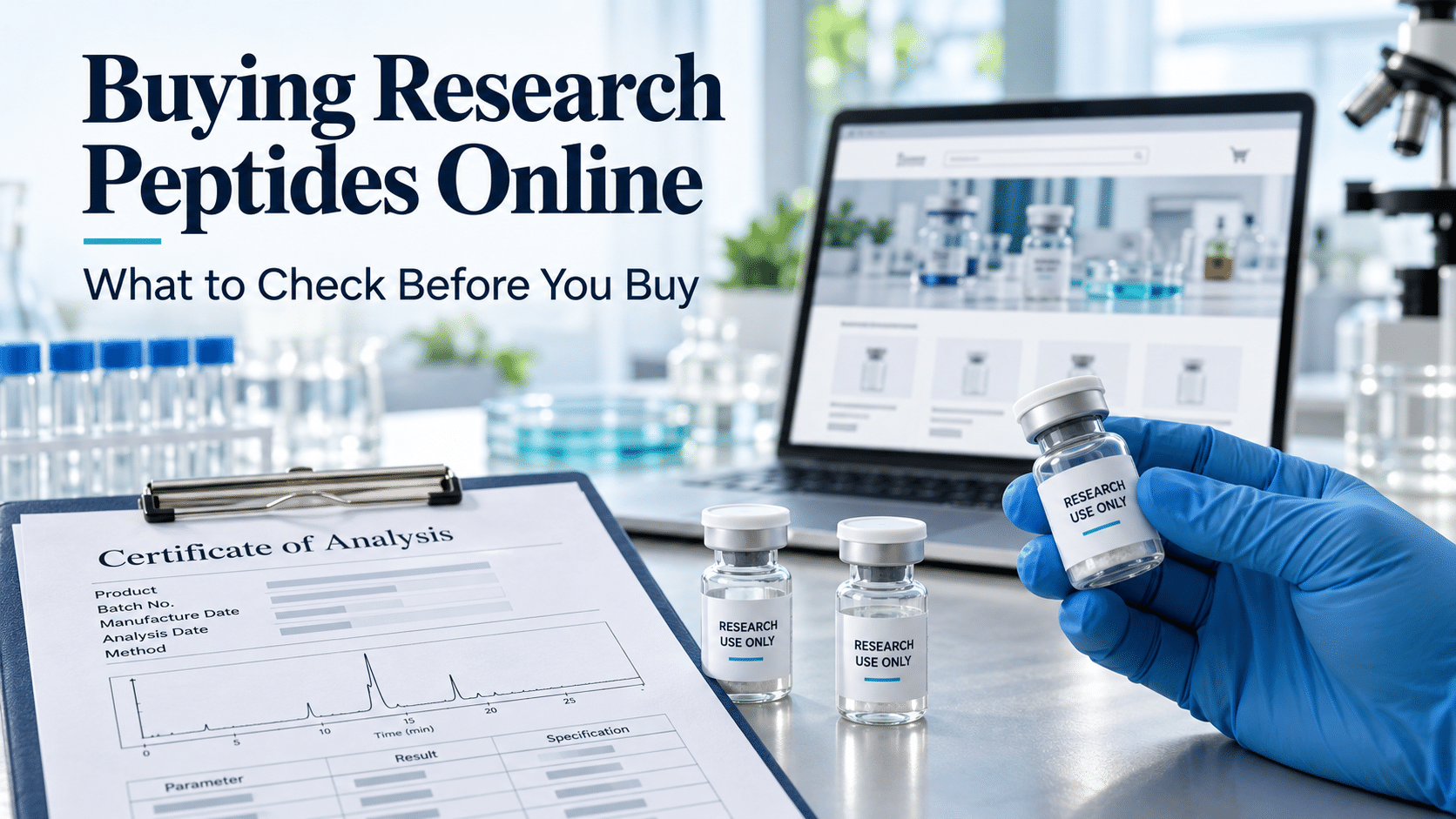
An online product listing can make a research peptide purchase look straightforward: select a compound, choose a quantity and pay. The harder question is whether the item in your basket matches the material your laboratory actually needs.
Before buying research peptides online, confirm the exact formulation and quantity, obtain the relevant batch documentation, review handling information and establish the full delivery terms. Resolve discrepancies before placing the order.
This guide focuses on checking a specific product and purchase for laboratory research. It is designed to help you move from an attractive listing to a documented ordering decision.
The checks to make before checkout
| Check | What you need to establish |
|---|---|
| Product identity | The selected item matches the compound and specification required by your protocol. |
| Quantity | The stated amount has a clear basis: gross material, peptide content or measured target compound. |
| Formulation | The supplied form, ingredients and concentration are appropriate for the planned work. |
| Batch evidence | Analytical documents can be linked to the material that will be dispatched. |
| Handling | Your laboratory has the information and facilities needed to receive and store it. |
| Order terms | Dispatch location, delivery timing, charges and responsibility for problems are clear. |
These are purchasing questions, not a universal certification standard. Your scientific lead should decide which specifications and tests are necessary for the experiment.
1. Check the selected product, not just the page headline
Start with the exact item in the basket. A product page may offer several quantities, formats or mixtures under one heading. Check the selected variant against the specification you intend to order.
Record the product name, catalogue reference, quantity per container, number of containers and supplied form. Where your protocol requires a particular sequence, modification or salt form, obtain that information explicitly.
For blends, request the identity and stated amount of each component. A combined total does not tell you how much of each ingredient is present.
Save the relevant specification with your order record. If a technical answer changes or qualifies what appears on the product page, ask for written confirmation tied to the selected item.
2. Establish what the quantity and purity figures mean
A milligram quantity and a purity percentage describe different aspects of a product. Neither should be interpreted without knowing its measurement basis.
Sigma-Aldrich distinguishes chromatographic peptide purity from peptide content: its HPLC purity measurement does not account for water and salts in the sample, whereas peptide content considers peptide material relative to the overall sample.[1]
This means that “10 mg, 99% purity” does not, by itself, demonstrate that a container contains 9.9 mg of the intended peptide. That calculation would require additional information about what the 10 mg represents and how the material was characterised.
Ask whether the quantity is a nominal fill, gross dry mass, net peptide content or measured amount of the target compound. For solutions, establish both the concentration and total volume, and ask how the concentration was determined.
If precise quantity is important to your experiment, request the supporting measurement rather than inferring it from the product title.
3. Read the complete formulation
Check which ingredients accompany the named peptide. Depending on the product, relevant information may include its salt form, solvent, buffer, stabilisers or other components of a mixture.
This is a scientific compatibility question. For example, peptide manufacturer AltaBioscience explains that its products can be supplied with different counterions and notes that trifluoroacetate associated with peptide purification can be problematic for cell cultures.[2] That does not establish that every product containing it is unsuitable; it gives a reason to check the formulation against the intended assay.
For a pre-mixed product, ask for enough compositional information to assess compatibility. If the supplier cannot disclose a component relevant to the experiment, record that uncertainty before proceeding.
Worked example: two listings labelled “10 mg”
The following is hypothetical and does not describe Coridion products.
| Listing | Information provided | Information still needed |
|---|---|---|
| Product A: lyophilised material, 10 mg, 99% HPLC purity | A dry format, a stated mass and a chromatographic result | What the stated mass represents; identity evidence; relevant salt or other components |
| Product B: pre-mixed solution, 10 mg total | A supplied solution and a stated total amount | Total volume; concentration basis; full formulation; testing relevant to the finished solution |
Neither description is enough to determine which product fits a particular protocol. Comparing price per advertised milligram would be premature until the missing specifications are resolved.
4. Connect the analytical documents to your order
Look for a certificate of analysis, or COA, that identifies the relevant product and batch. Check the test methods, results, report date and issuing organisation.
FDA guidance discussing pharmaceutical active ingredients refers to ICH Q7 recommendations for batch identifiers, release dates, tests, acceptance limits and numerical results on a COA.[3] These are useful document-review principles, although that pharmaceutical guidance is not a universal legal requirement for UK research reagents. Here is more insight into peptide legality in the UK.
For your order, answer three questions:
- Does the certificate describe the selected product? Check the compound, form and any stated formulation.
- Will the delivered lot match the document? If allocation happens at dispatch, establish how you will receive the applicable COA.
- What material was tested? Ask whether the report covers starting material, a formulated bulk batch or the final supplied product.
Where independent testing is claimed, identify the laboratory and ask how the report can be authenticated. Keep the scope of the evidence clear: a report on a tested sample should not be interpreted as a record of individual testing for every container.
What if the website only shows a sample COA?
A sample certificate can show what information a supplier usually provides. It leaves the results for your allocated batch unresolved. Ask for the applicable document or a written explanation of when it will be supplied before committing to an order whose acceptance depends on those results.
5. Distinguish quality documents from handling documents
A COA and a safety data sheet serve different purposes. Do not treat the presence of one as a substitute for the other.
| Document | What to use it for |
|---|---|
| Product specification | Defining what is being ordered and which requirements it should meet |
| COA or analytical report | Reviewing the reported tests and results for the identified material |
| Safety data sheet, where applicable | Understanding hazards, handling, storage and emergency information |
| Order confirmation or invoice | Recording the seller, selected item, quantity and commercial terms |
The Health and Safety Executive explains that safety data sheets help users assess chemical hazards. It also explicitly distinguishes an SDS from the workplace risk assessment itself.[4]
Request the handling information appropriate to the product and pass it to the person responsible for your laboratory’s assessment. A short online description should not be your only source of handling information.
6. Plan receipt and storage before ordering
Confirm that your laboratory can meet the stated storage conditions when the shipment arrives. Ask for the expiry or retest date, any conditions attached to it and separate guidance for material after opening where relevant.
Published consensus recommendations for peptides used in mass-spectrometry-based assays emphasise the importance of procurement, characterisation, storage and handling. They also explain that appropriate storage conditions depend on the peptide sequence.[5]
The practical implication is to seek information specific to the material and supplied form. Do not transfer a shelf-life claim from one compound or formulation to another.
Before paying, clarify the expected dispatch date and shipping conditions. If the laboratory cannot receive deliveries over a weekend or holiday, arrange a suitable window. Ask how delays or suspected temperature excursions should be documented and assessed.
7. Confirm dispatch location and the full delivered cost
A website displaying sterling prices does not establish that the parcel will be dispatched from the UK. Ask where this particular order will ship from and which legal entity will issue the invoice.
For overseas dispatch, establish who handles customs clearance and whether the quoted amount includes relevant taxes, duties and handling charges. GOV.UK’s importing guidance identifies customs arrangements, classification, valuation and checks for applicable licences or certificates as part of the import process. Requirements differ by route, including movements involving Northern Ireland.[6]
Use that guidance for the actual transaction rather than assuming that every research peptide order follows the same rules.
For budgeting, compare the total delivered cost once the product specifications are clear. Include any testing your laboratory will commission before accepting the material.
Also ask what happens if the supplier cannot fulfil the selected item: will it wait, refund or propose a substitute? Require approval before a different formulation, quantity or product is dispatched.
8. Agree how discrepancies will be handled
Read the process for incorrect products, missing documents, damaged packaging and disputed specifications. Clarify who to contact, what records are needed and any reporting deadlines.
Before ordering a material your experiment depends on, ask how the supplier would handle a mismatch between the delivered lot and the accompanying certificate. The answer should give you an actionable process.
On receipt, compare the delivery with the saved specification and order confirmation. Record the lot identifier and check that the supporting documents match. Follow your laboratory’s procedure for holding material pending review if something is unresolved.
This receiving check completes the purchasing process. A correct online order does not eliminate the need to verify what arrived.
If you need more help check out our peptide buyer’s guide.
Do not confuse research availability with medicinal approval
An online checkout, research-use label or analytical report does not establish that a product is authorised for human treatment.
The MHRA assesses whether a product is a medicine using factors including its claims, properties, intended purpose and presentation.[7] The relevant status cannot be determined from the phrase “research use only” in isolation.
This article concerns laboratory procurement. Any project involving medicinal use needs the appropriate regulatory and institutional assessment for that project.
A final check before paying
Proceed when the selected item meets your documented requirements and any evidence needed for acceptance will be available. Pause if an unresolved specification could change the purchase decision.
In particular, resolve an unexplained quantity, an undisclosed formulation component relevant to your assay, a batch-document mismatch or unclear import responsibility before ordering.
When reviewing research peptides at Coridion Sciences, identify the exact product and format first, then request the information needed to assess it against your laboratory’s requirements. Keep the answers with the order so the person receiving the shipment can complete the same checks.
Sources
- Sigma-Aldrich. Peptide Sample Amount Determination. Primary technical explanation of chromatographic purity and peptide content.
- AltaBioscience. Peptide Purification and Product Analysis. Manufacturer-authored technical explanation of purification, salt forms and analytical methods. Used for the specific counterion example, not as an independent endorsement of a supplier.
- US Food and Drug Administration. Questions and Answers on Current Good Manufacturing Practice Requirements: Control of Components and Drug Product Containers and Closures. Question 15 discusses ICH Q7 COA contents for active pharmaceutical ingredients; cited as a documentation benchmark.
- Health and Safety Executive. Chemical Safety Data Sheets. Official guidance on SDS information and its relationship to workplace risk assessment.
- Hoofnagle AN et al. Recommendations for the Generation, Quantification, Storage, and Handling of Peptides Used for Mass Spectrometry–Based Assays. Clinical Chemistry, 2016. Full text. Consensus recommendations for the stated analytical application, not a universal storage specification.
- GOV.UK. Import Goods into the UK: Step by Step. Official guidance on importing arrangements and route-specific requirements. Accessed 9 October 2026.
- Medicines and Healthcare products Regulatory Agency. Borderline Products: How to Tell if Your Product Is a Medicine. Official guidance on medicinal-product classification. Accessed 9 October 2026.