
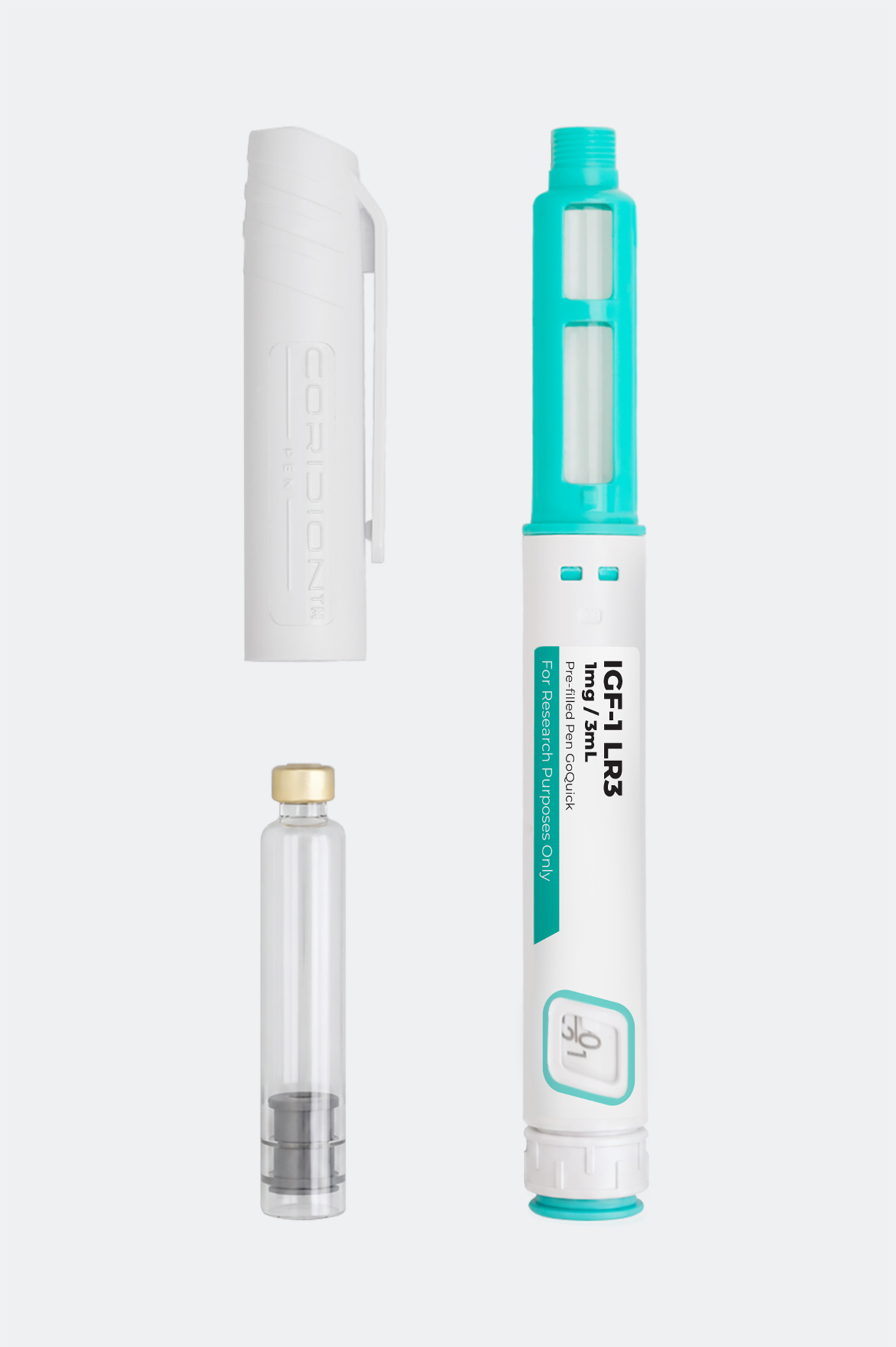
IGF-1 LR3 Peptide 1mg (3ml Pen) – Growth Factor and IGF-1 Receptor Research
An engineered IGF-1 analogue modified to evade binding protein sequestration, giving it substantially extended activity. Research use only.
IGF-1 Signalling
Muscle Protein Synthesis
Anabolic Signalling
Description
IGF-1 LR3 peptide, also known as Long R3 IGF-1 or Long Arginine-3 Insulin-Like Growth Factor-1, is an engineered analogue of human insulin-like growth factor 1 (IGF-1).
Developed for experimental research, IGF-1 LR3 contains 83 amino acids and incorporates two structural modifications designed to alter its interaction with insulin-like growth factor-binding proteins (IGFBPs).
These modifications distinguish IGF-1 LR3 from naturally occurring human IGF-1, which consists of 70 amino acids and is extensively regulated by circulating binding proteins.
The analogue has attracted scientific interest in IGF-1 receptor signalling, cell growth, protein metabolism and growth factor biology.
Its reduced affinity for IGF-binding proteins makes it particularly relevant to laboratory studies in which researchers wish to investigate IGF-1 receptor activity under conditions where binding proteins can influence the availability of native IGF-1.
IGF-1 LR3 1mg is supplied in a 3ml pen format by Coridion Sciences for scientific and laboratory investigation.
What Is IGF-1 LR3?
IGF-1 LR3 is a modified analogue of insulin-like growth factor 1, a naturally occurring peptide hormone involved in cellular growth, metabolism and tissue development.
Native human IGF-1 contains 70 amino acids and is produced primarily in the liver under the influence of growth hormone, although local IGF-1 production also occurs in other tissues.
IGF-1 LR3 incorporates two important structural modifications.
1. Arginine substitution at position 3
In the IGF-1-derived portion of the analogue, glutamic acid at position 3 is replaced by arginine.
This modification contributes to changes in the molecule’s interaction with IGF-binding proteins.
2. A 13-amino-acid N-terminal extension
An additional 13 amino acids are attached to the beginning of the native IGF-1 sequence.
This produces a final peptide containing 83 amino acids.
Together, these structural changes reduce the analogue’s affinity for IGF-binding proteins while retaining substantial IGF-1 receptor agonist activity.
The result is a useful experimental compound for investigating growth factor signalling in biological systems.
IGF-1 LR3 Compared with Natural IGF-1
Although IGF-1 LR3 is derived from human IGF-1, the two compounds are not identical.
Native IGF-1 circulates largely bound to IGF-binding proteins, which influence its distribution, clearance and availability to receptors.
The major IGF-binding protein family includes IGFBP-1 through IGFBP-6.
These proteins contribute to the regulation of IGF-1 activity in different tissues and experimental environments.
IGF-1 LR3 was developed to reduce binding-protein interactions.
This is especially relevant in laboratory experiments involving cultured cells, where the presence of IGFBPs can influence how much added IGF-1 remains available for receptor activation.
Key Structural Differences
Native IGF-1
- Contains 70 amino acids.
- Interacts strongly with IGF-binding proteins.
- Activates IGF-1 receptors.
- Participates in endogenous growth and metabolic regulation.
- Has well-characterised physiological roles in humans.
IGF-1 LR3
- Contains 83 amino acids.
- Includes an arginine substitution at position 3 of the IGF-1 sequence.
- Contains an additional 13-amino-acid N-terminal extension.
- Has reduced affinity for IGF-binding proteins.
- Is used as an experimental analogue in growth factor research.
Reduced binding-protein affinity can increase apparent activity in some cell-culture experiments, but it should not automatically be interpreted as a longer circulating half-life.
Pharmacokinetic studies must distinguish receptor availability, peptide clearance and the protective effects of binding proteins.
How Does IGF-1 LR3 Work?
IGF-1 LR3 is principally investigated in relation to activation of the insulin-like growth factor 1 receptor (IGF-1R).
IGF-1R is a receptor tyrosine kinase involved in regulating cellular growth, survival, differentiation and metabolism.
Receptor activation initiates several intracellular signalling pathways.
IGF-1 Receptor Activation
The IGF-1 receptor is expressed across a range of tissues and cell types.
When activated, the receptor undergoes autophosphorylation and recruits signalling proteins that transmit information within the cell.
IGF-1 LR3 retains agonist activity at IGF-1R, allowing researchers to study receptor-mediated responses under experimental conditions.
The resulting biological effects depend on cell type, receptor expression, exposure conditions and other growth signals.
PI3K/Akt Signalling
The phosphoinositide 3-kinase (PI3K)/Akt pathway is an important intracellular signalling system associated with cell survival, nutrient regulation and protein metabolism.
IGF-1 receptor activation can stimulate PI3K-associated signalling, leading to downstream Akt activation.
Akt participates in several cellular processes, including the regulation of apoptosis-related mechanisms, glucose transport and protein synthesis-associated pathways.
Research involving IGF-1 LR3 can help investigate how altered IGF-binding protein affinity influences these responses in experimental systems.
However, activity within the PI3K/Akt pathway does not establish improved muscle growth or metabolic health in humans.
MAPK/ERK Signalling
The mitogen-activated protein kinase (MAPK) pathway plays an important role in cellular proliferation and differentiation.
IGF-1 receptor activation can engage the Ras/Raf/MEK/ERK signalling cascade.
Experimental studies use IGF-1-related compounds to investigate the contribution of this pathway to cell-cycle regulation and other biological responses.
These pathways are not exclusive to skeletal muscle and operate across many tissue types.
IGF-Binding Protein Interactions
One of IGF-1 LR3’s defining properties is its reduced binding to IGFBPs.
In laboratory conditions, this can alter the amount of growth factor available to interact with cellular receptors.
This feature makes the analogue particularly useful for investigating the relationship between binding proteins and IGF-1 receptor activity.
Importantly, IGFBPs also influence the stability and clearance of endogenous IGF-1.
Consequently, reduced IGFBP affinity should not be presented as proof of prolonged systemic activity.
IGF-1 LR3 and Growth Research
IGF-1 signalling is associated with a wide range of physiological processes, including cellular growth, protein metabolism and tissue development.
Experimental investigations involving IGF-1 LR3 have examined aspects of these processes.
Muscle Cell Biology
Skeletal muscle contains specialised cells involved in contraction, maintenance and adaptation.
Growth factor research has examined how IGF-1 signalling influences muscle cell differentiation, protein metabolism and cellular responses to experimental growth stimuli.
IGF-1 LR3 has been used in laboratory models to investigate these pathways.
However, evidence from cell-culture experiments does not establish increased muscle mass, strength or athletic performance in humans.
Protein Synthesis-Associated Signalling
Cellular protein synthesis is regulated by interactions between growth factor signalling, nutrient availability and intracellular molecular pathways.
IGF-1R-associated activation of PI3K/Akt can influence downstream systems involved in protein metabolism.
Laboratory studies may use IGF-1 LR3 to investigate these cellular responses.
Its activity should not be equated with proven anabolic effects in humans.
Cell Proliferation and Differentiation
IGF-1 receptor signalling participates in the regulation of cell proliferation and differentiation across different tissues.
Researchers have used IGF-1 analogues in laboratory systems examining cell growth and survival.
Because growth factor signalling is not restricted to healthy tissues, these mechanisms also require careful interpretation in research involving abnormal cell proliferation.
Scientific Research Applications
1. IGF-1 Receptor Pharmacology
IGF-1 LR3 provides an experimental model for investigating receptor activation and downstream signalling associated with IGF-1R.
Its molecular modifications allow researchers to examine how binding-protein interactions influence receptor responses.
2. Cell Culture Research
IGF-1 LR3 has been used in mammalian cell-culture systems, including experiments involving growth factor-dependent cellular activity.
Its reduced affinity for IGF-binding proteins is especially relevant in culture conditions where binding proteins may influence the availability of native IGF-1.
However, its use and biological effects depend on the particular cell type and experimental environment.
3. IGFBP Research
The IGF-binding protein family plays an important role in regulating growth factor distribution and activity.
IGF-1 LR3 provides a useful comparison compound for investigating IGFBP-associated mechanisms.
Comparing native IGF-1 with modified analogues can help clarify the contribution of binding proteins to observed cellular responses.
4. Skeletal Muscle Research
Studies involving IGF-related signalling have examined myoblast differentiation, muscle protein metabolism and responses to experimental stimuli.
IGF-1 LR3 is relevant to these investigations because of its receptor activity and altered binding-protein interactions.
Clinical benefits for muscle development or exercise performance have not been established for this analogue.
5. Cellular Survival and Differentiation
IGF-1 signalling participates in pathways associated with cell survival, proliferation and differentiation.
Experimental work involving IGF-1 LR3 helps researchers examine these signalling mechanisms under controlled laboratory conditions.
6. Growth Factor Structure–Activity Relationships
The difference between native IGF-1 and its LR3 analogue provides an opportunity to investigate how small structural changes influence peptide behaviour.
Research can compare receptor affinity, binding-protein interactions, molecular stability and cellular responses.
These characteristics make IGF-1 LR3 relevant to growth factor chemistry as well as broader cellular biology.
IGF-1 LR3 and the Growth Hormone–IGF-1 Axis
Growth hormone and IGF-1 participate in a connected endocrine signalling system.
Growth hormone is released from the anterior pituitary and stimulates IGF-1 production in the liver and other tissues.
IGF-1 subsequently interacts with receptors involved in cellular growth and metabolism.
However, IGF-1 LR3 acts differently from peptides that stimulate growth hormone secretion.
IGF-1 LR3 is designed to interact with the IGF-1 receptor pathway.
By contrast, growth hormone secretagogues and growth hormone-releasing hormone analogues act upstream in the endocrine signalling system.
This distinction is important when comparing related research compounds.
For complementary research into endocrine growth pathways, explore our Growth & Performance peptide collection, featuring compounds with different mechanisms of action.
IGF-1 LR3 Compared with Related Research Peptides
IGF-1 LR3 – IGF-1 Receptor Research
IGF-1 LR3 is an 83-amino-acid analogue investigated primarily for its reduced affinity for IGF-binding proteins and retained IGF-1 receptor activity.
Its main scientific distinction is its altered interaction with IGFBPs.
Ipamorelin – Ghrelin Receptor Research
Ipamorelin is a synthetic growth hormone secretagogue investigated for its activity at the ghrelin receptor, also known as GHSR1a.
Its mechanism involves endocrine signalling associated with growth hormone release rather than direct IGF-1 receptor agonism.
Sermorelin – GHRH Receptor Research
Sermorelin is a synthetic fragment of growth hormone-releasing hormone.
It has been investigated for its effects on pituitary GHRH receptor signalling and growth hormone secretion.
Unlike IGF-1 LR3, Sermorelin acts upstream of the IGF-1 receptor pathway.
HGH Somatropin – Growth Hormone Research
HGH Somatropin is a recombinant form of human growth hormone.
It interacts with growth hormone receptors and influences downstream endocrine processes, including IGF-1 production.
These compounds have different receptor targets and should not be treated as interchangeable.
Important Research Limitations and Safety Considerations
IGF-1 LR3 has a substantial laboratory research history, but clinical evidence concerning its safety and effectiveness in humans remains insufficient.
The modified peptide should not be confused with approved pharmaceutical IGF-1 preparations, such as mecasermin.
Even where two compounds act through related growth factor pathways, differences in structure, binding-protein affinity and pharmacokinetics can substantially alter their properties.
IGF-related signalling can also affect glucose regulation and cell proliferation.
Consequently, experimental findings must be interpreted in the context of potential metabolic and proliferative risks rather than assuming that greater receptor activation is beneficial.
No established human dosing, long-term safety profile or therapeutic indication exists for this IGF-1 LR3 research formulation.
IGF-1 LR3 1mg Product Specifications
- Product: IGF-1 LR3
- Alternative names: Long R3 IGF-1, Long Arginine-3 IGF-1
- Quantity: 1mg
- Format: 3ml pen
- Classification: Modified insulin-like growth factor analogue
- Peptide length: 83 amino acids
- Parent molecule: Human IGF-1
- Structural modifications: Arginine substitution at position 3 of native IGF-1 and a 13-amino-acid N-terminal extension
- Primary molecular target: IGF-1 receptor (IGF-1R)
- Key research characteristic: Reduced affinity for IGF-binding proteins
- Associated pathways: PI3K/Akt and MAPK/ERK
- Primary research focus: IGF-1 receptor signalling and IGFBP interactions
- Additional research areas: Cell proliferation, differentiation, muscle cell biology and growth factor pharmacology
- Evidence status: Laboratory and animal research; no established human clinical efficacy for IGF-1 LR3
Growth Factor Research at Coridion Sciences
Coridion Sciences supplies specialist research peptides and experimental compounds covering endocrine signalling, growth factor biology and cellular physiology.
IGF-1 LR3 1mg forms part of the company’s research range involving growth and performance-associated molecular pathways.
Its modified structure makes it particularly relevant to the study of IGF-binding proteins and receptor-mediated cellular responses.
Researchers examining related biological mechanisms can also explore the wider Hormone Vitality research collection, featuring compounds associated with different endocrine signalling pathways.
Research Use Only: IGF-1 LR3 is an experimental research compound intended exclusively for scientific and laboratory investigation. It is not approved for human consumption, muscle enhancement, athletic performance improvement or other therapeutic applications. Human safety, pharmacokinetics and clinical efficacy have not been established.
Mechanisms of Action
IGF-1 LR3 is a 83-amino-acid analogue of human IGF-1 incorporating an arginine substitution at position 3 and a 13-residue N-terminal extension. Research describes the arginine substitution as substantially reducing affinity for IGF binding proteins, leaving a greater free fraction available for receptor engagement. Signalling proceeds through the IGF-1 receptor tyrosine kinase with downstream PI3K/Akt and MAPK pathway activation, affecting protein synthesis, cell proliferation and apoptosis resistance. Cross-reactivity with the insulin receptor at higher concentrations is documented.
Research Status & Findings
A substantial literature, much of it in cell culture applications where the analogue is a standard reagent, alongside animal work on muscle and tissue growth endpoints.
Cell culture research
Widespread use as a serum-free media supplement across cell lines.
Binding protein evasion
Characterisation of reduced IGFBP affinity conferred by the R3 substitution.
Muscle research
Animal studies on protein synthesis and hypertrophy endpoints.
Receptor signalling
Mechanistic work on PI3K/Akt and MAPK pathway activation.
Anti-doping context
IGF-1 analogues are listed by anti-doping authorities.
*For research purposes only – not for human consumption*

As Seen In The Press
Peptides can affect the way the body functions at a cellular level.

Our 3 Step System
Pre-filled Cartridges
Engineered for absolute accuracy and ease. Our pre-blended pens make precise dosing completely seamless in just three quick steps.
Step 1 - Remove the Pre-mixed pen from the box
Step 2 - Secure the needle tip
Step 3 - Twist to set the required dose

Blends
Blends

Sermorelin + GHRP-6 – 5mg / 5mg (3ml Pen)
Sermorelin + GHRP-6 5mg/5mg combines a 29-amino-acid GHRH analogue with a synthetic ghrelin receptor agonist. Investigated for complementary growth hormone signalling pathways, pituitary hormone. Research use only.
£95.00
Blends
Sermorelin + GHRP-2 – 5mg / 5mg (3ml Pen)
Sermorelin + GHRP-2 5mg/5mg combines a 29-amino-acid GHRH analogue with a synthetic growth hormone secretagogue. Investigated for complementary pituitary signalling, ghrelin receptor activation and. Research use only.
£99.00
Blends
Longevity Blend (Glutathione / NAD+ / Resveratrol) – 500mg / 100mg / 500mg (3ml Pen)
Three pillars of cellular ageing research in one pen. Pairs antioxidant defence, NAD+ coenzyme power, and sirtuin-modulating activity. Research use only. Research use only.
£129.00
Blends
Vitality Blend (Glutathione / NMN / Resveratrol) – 500mg / 500mg / 500mg (3ml Pen)
The NAD+ precursor evolution. Swaps direct NAD+ for NMN — the biosynthetic precursor the cell uses via the salvage pathway. Research use only. Research use only.
£129.00
Blends
SS-31 + MOTS-c – 10mg / 10mg (3ml Pen)
Two mitochondrial compounds acting on different layers of the same biology — membrane structure and mitokine signalling. Research use only. Research use only.
£139.00
Blends
SS-31 + MOTS-c + NAD+ – 10mg / 10mg / 200mg (3ml Pen)
The flagship triple combination of mitochondrial research. SS-31, MOTS-c and NAD+ each act on a different layer of cellular energy biology — structure, signal. Research use only.
£159.00
Blends
KLOW Blend Peptide – BPC-157, TB-500, KPV & GHK-Cu (3ml Pen)
KLOW Blend Peptide combines BPC-157 10mg, TB-500 10mg, KPV 10mg and GHK-Cu 50mg in a four-component research formulation. The blend brings together compounds studied. Research use only.
£105.00
Blends
CJC-1295 (No DAC) + Ipamorelin + GHRP-2 – 3mg / 3mg / 3mg (3ml Pen)
A three-component preparation pairing a GHRH analogue with both a selective and a higher-potency ghrelin agonist. Research use only. Research use only.
£95.00
Blends
Glow Blend Peptide – BPC-157, TB-500 & GHK-Cu (3ml Pen)
Glow Blend Peptide combines GHK-Cu 50mg, BPC-157 10mg and TB-500 10mg in a three-component research formulation. Its ingredients have been investigated individually for extracellular. Research use only.
£95.00


