
MOTS-c Peptide (3ml Pen) – Mitochondrial Signalling and Cellular Energy Research
A mitochondrial-derived peptide that rewrote assumptions about where cellular signals originate — encoded in the mitochondrial genome, not the nucleus. Research use only.
Mitokine Signalling
Mitochondrial Function
Metabolic Regulation
Description
MOTS-c peptide is a naturally occurring mitochondrial-derived peptide investigated for its involvement in metabolic regulation, cellular energy signalling and biological responses to physiological stress.
Unlike most peptides, which are encoded by nuclear DNA, MOTS-c originates from a short open reading frame within the mitochondrial genome.
This distinctive origin makes MOTS-c an important compound in research exploring how mitochondria communicate with other parts of the cell and influence broader metabolic processes.
Since its identification in 2015, published studies have investigated MOTS-c in relation to AMPK activation, glucose metabolism, skeletal muscle physiology, exercise-associated responses and ageing-related biological changes.
The scientific literature includes molecular experiments, animal studies and observational investigations involving naturally occurring MOTS-c in humans.
However, there is insufficient clinical evidence to establish that externally administered MOTS-c improves human metabolism, physical performance or longevity.
Coridion Sciences supplies MOTS-c in a 3ml pen format for scientific and laboratory research.
What Is MOTS-c?
MOTS-c stands for Mitochondrial Open Reading Frame of the Twelve-S rRNA, type c.
It is a 16-amino-acid peptide encoded by a short open reading frame associated with the mitochondrial 12S ribosomal RNA gene, MT-RNR1.
Its amino-acid sequence is:
Met-Arg-Trp-Gln-Glu-Met-Gly-Tyr-Ile-Phe-Tyr-Pro-Arg-Lys-Leu-Arg
Abbreviated sequence:
MRWQEMGYIFYPRKLR
MOTS-c belongs to a group of compounds known as mitochondrial-derived peptides (MDPs).
These peptides have attracted scientific interest because they suggest mitochondria participate in cellular communication through mechanisms extending beyond ATP production.
MOTS-c has also been described as a mitokine, reflecting its proposed role as a mitochondrial-origin signal that can influence cellular and systemic metabolic responses.
Researchers have investigated this signalling activity in skeletal muscle, metabolic tissues and experimental models of cellular stress.
MOTS-c and Mitochondrial Research
Mitochondria are cellular organelles involved in energy metabolism, biochemical signalling and the regulation of numerous physiological processes.
They contain their own DNA, which encodes a small number of proteins and RNA molecules.
The discovery of mitochondrial-derived peptides expanded the scientific understanding of mitochondrial genetics and signalling.
MOTS-c is particularly relevant because of its reported interactions with pathways associated with cellular energy balance and metabolic adaptation.
Major research areas include:
- AMPK signalling: Investigating the activation of an important cellular energy-sensing pathway.
- Glucose metabolism: Examining glucose uptake and insulin-associated responses in experimental models.
- Metabolic stress adaptation: Studying how cells respond to changing energy availability.
- Skeletal muscle physiology: Investigating cellular metabolic processes in muscle tissue.
- Exercise-associated signalling: Examining changes in endogenous MOTS-c during physical activity.
- Cellular ageing: Exploring associations between MOTS-c, metabolic regulation and age-related biological processes.
These mechanisms are relevant to mitochondrial biology but do not establish clinical benefits from MOTS-c administration in humans.
Researchers investigating similar pathways can explore our cellular energy and mitochondrial research compounds, featuring peptides and other compounds studied in relation to energy metabolism.
How Does MOTS-c Work?
MOTS-c has been investigated through several interconnected molecular pathways.
Its complete mechanism remains incompletely characterised, and experimental findings can vary according to the biological model.
AMPK Activation and Energy Signalling
AMP-activated protein kinase (AMPK) is an important cellular regulator involved in energy homeostasis.
AMPK responds to changes in cellular energy status and helps coordinate metabolic processes associated with energy production and consumption.
The original 2015 MOTS-c study reported AMPK-related activity in laboratory and animal models.
Researchers linked this activity to changes in metabolic pathways involving folate metabolism and purine biosynthesis.
These findings established an experimental basis for investigating MOTS-c as a mitochondrial-derived metabolic regulator.
However, MOTS-c should not be described as a clinically proven AMPK activator in humans.
Folate–Methionine and Purine Metabolism
One of the more distinctive aspects of MOTS-c research involves its reported influence on the folate–methionine cycle and de novo purine biosynthesis.
The folate cycle participates in one-carbon metabolism, supporting biochemical processes involved in nucleotide production and methylation.
Purine biosynthesis contributes to the production of molecules required for DNA, RNA and cellular energy metabolism.
The original MOTS-c research programme reported changes in these interconnected pathways.
These effects were associated with altered cellular metabolic intermediates and downstream AMPK activation in the experimental systems studied.
This mechanism differentiates MOTS-c from compounds that act directly through GLP-1 receptors or other endocrine signalling pathways.
Nuclear Translocation During Cellular Stress
Although MOTS-c originates from mitochondrial DNA, experimental studies have reported that it can relocate to the nucleus under certain metabolic stress conditions.
Researchers have investigated its potential involvement in the regulation of stress-responsive gene expression.
This process is relevant to mitochondrial-to-nuclear communication, sometimes described as retrograde signalling.
Such communication allows mitochondria-associated processes to influence wider cellular responses.
However, the molecular details and physiological significance of MOTS-c nuclear activity require continued investigation.
Glucose Uptake and Insulin-Associated Research
Glucose is a major metabolic substrate used by many cell types, including skeletal muscle cells.
Research involving MOTS-c has examined changes in glucose handling and insulin-associated metabolic responses.
A 2015 study reported that MOTS-c influenced glucose metabolism in cultured cells and protected against selected metabolic abnormalities in mouse models.
These findings provide scientific support for investigating MOTS-c in metabolic physiology.
They do not establish that MOTS-c treats insulin resistance or diabetes in humans.
MOTS-c and Exercise Physiology
Exercise-associated research is one of the most interesting areas of MOTS-c investigation.
Physical activity produces coordinated metabolic responses involving skeletal muscle, mitochondrial activity and cellular energy regulation.
A 2021 study published in Nature Communications investigated MOTS-c in relation to exercise and ageing.
The researchers reported changes in endogenous MOTS-c following exercise in human participants.
The same research programme investigated administered MOTS-c in mice and reported changes in physical performance and age-associated muscle-related outcomes.
These findings suggest that MOTS-c participates in biological responses associated with physical activity.
However, the human observations primarily concern naturally occurring MOTS-c, while the intervention findings were obtained in animals.
Consequently, the study does not establish that MOTS-c administration improves exercise performance in humans.
MOTS-c and Cellular Ageing Research
Ageing involves multiple biological processes, including changes in mitochondrial function, cellular stress responses and metabolic regulation.
MOTS-c has been investigated in this wider context because of its association with energy signalling and physiological adaptation.
Age-Associated Metabolic Changes
Some observational research has examined circulating MOTS-c concentrations in relation to age and metabolic characteristics.
Findings have varied across populations and study designs.
Associations between MOTS-c concentrations and ageing-related markers do not establish a causal relationship or a therapeutic effect.
Mitochondrial Stress Responses
Mitochondria respond to physiological stress through a range of adaptive mechanisms.
MOTS-c has been investigated as a signalling component associated with these responses.
Experimental studies have examined its relationship with AMPK activity, stress-responsive gene expression and metabolic regulation.
These investigations contribute to our understanding of mitochondrial biology without establishing human lifespan extension.
Metabolic Flexibility
Metabolic flexibility refers to the ability of cells and tissues to adapt their fuel use according to changing physiological conditions.
MOTS-c research has examined processes relevant to glucose handling and metabolic adaptation.
However, there is insufficient clinical evidence that externally supplied MOTS-c improves metabolic flexibility in humans.
Researchers exploring related ageing-associated pathways can also browse our longevity and cellular ageing research collection.
Scientific Research Applications
1. Mitochondrial-Derived Peptide Biology
MOTS-c provides an experimental model for investigating how peptides encoded within mitochondrial DNA influence cellular processes.
Its discovery has contributed to a broader understanding of mitochondria as signalling organelles.
2. AMPK and Metabolic Regulation
Research involving MOTS-c has investigated AMPK-associated signalling and changes in cellular metabolic pathways.
These studies are relevant to understanding energy-sensing mechanisms.
3. Skeletal Muscle Metabolism
MOTS-c has been investigated in relation to glucose uptake and muscle-associated metabolic responses.
Animal research has also examined changes in experimental physical performance measures.
4. Exercise-Induced Signalling
Human observational investigations have reported changes in endogenous MOTS-c associated with exercise.
These findings have prompted additional research into the relationship between physical activity and mitochondrial-origin signalling peptides.
5. Cellular Stress Adaptation
Experimental studies have examined MOTS-c nuclear translocation and stress-responsive gene expression.
This research contributes to understanding mitochondrial communication with the nucleus.
6. Ageing-Associated Metabolic Biology
MOTS-c has been investigated in models involving age-dependent changes in metabolism and physical function.
These findings remain predominantly preclinical.
MOTS-c Compared with Other Mitochondrial Research Compounds
MOTS-c – Mitochondrial Signalling Peptide
MOTS-c is a 16-amino-acid mitochondrially encoded peptide investigated for AMPK-associated signalling, metabolic regulation and cellular stress adaptation.
Its principal scientific distinction is its role in mitochondrial-origin signalling.
SS-31 – Mitochondrial Membrane Research
SS-31, also known as elamipretide, is a synthetic tetrapeptide investigated for interactions with cardiolipin and the inner mitochondrial membrane.
Its molecular origin and mechanisms differ substantially from MOTS-c.
Humanin – Mitochondrial-Derived Neuropeptide
Humanin is another mitochondrial-derived peptide investigated for cellular survival, apoptosis-associated pathways and neuronal stress responses.
Although both belong to the mitochondrial-derived peptide family, their sequences and research histories differ.
SS-31 + MOTS-c – Dual Research Formulation
The SS-31 + MOTS-c research blend combines compounds associated with different areas of mitochondrial biology.
SS-31 has been studied primarily for mitochondrial membrane-associated mechanisms, while MOTS-c has been investigated for metabolic signalling.
Their individual findings do not establish improved effects from combining them.
5-Amino-1MQ – NNMT Inhibitor Research
5-Amino-1MQ is an experimental small-molecule NNMT inhibitor associated with nicotinamide metabolism and NAD+ salvage research.
Unlike MOTS-c, it is not a peptide and is not encoded by mitochondrial DNA.
MOTS-c Product Specifications
- Product: MOTS-c
- Full designation: Mitochondrial Open Reading Frame of the Twelve-S rRNA, type c
- Format: 3ml pen
- Classification: Mitochondrial-derived research peptide
- Peptide length: 16 amino acids
- Amino-acid sequence: MRWQEMGYIFYPRKLR
- Genetic origin: Mitochondrial 12S rRNA gene (MT-RNR1)
- Research-associated pathway: AMPK signalling
- Additional mechanisms: Folate–purine metabolism and stress-associated nuclear signalling
- Primary research focus: Mitochondrial communication and metabolic regulation
- Additional research areas: Exercise physiology, skeletal muscle metabolism and cellular ageing
- Evidence status: Primarily preclinical research with some human observational findings
- Product quantity: Dependent on the selected variation
MOTS-c Research at Coridion Sciences
Coridion Sciences supplies specialist research peptides and experimental formulations for scientific investigations involving metabolic processes, mitochondrial biology and cellular signalling.
MOTS-c forms part of the company’s mitochondrial and cellular energy research range, alongside compounds with distinct molecular mechanisms and experimental evidence bases.
For investigations focused specifically on mitochondrial-derived metabolic signalling, the standalone MOTS-c compound should be distinguished from multi-component research blends containing SS-31 or other compounds.
Research Use Only: MOTS-c is an experimental peptide supplied for scientific and laboratory investigation. It is not approved for human consumption, weight management, athletic performance enhancement, anti-ageing therapy or other therapeutic applications. Human clinical safety, pharmacokinetics and efficacy have not been established.
Mechanisms of Action
MOTS-c is a 16-amino-acid peptide encoded within the mitochondrial 12S rRNA gene. Research describes translocation to the nucleus under metabolic stress, where it is reported to influence adaptive gene expression, and activation of the AMPK pathway with downstream effects on glucose uptake and fatty acid oxidation. Studies also document interaction with the folate–methionine cycle and de novo purine biosynthesis. Its classification as a mitokine — a mitochondrially encoded signal acting beyond the organelle — is the framework most of the current mechanistic work operates within.
Research Status & Findings
A relatively young literature, concentrated in animal models and cell systems, with a growing body of human observational work linking endogenous levels to metabolic and ageing markers.
Metabolic research
Studies on insulin sensitivity and glucose handling in rodent models.
Exercise physiology
Research on endogenous expression changes in response to physical stress.
Ageing research
Observational work correlating circulating levels with age and metabolic status.
Mechanistic studies
Characterisation of AMPK activation and nuclear translocation under stress.
Mitokine biology
Foundational research establishing the mitochondrial-derived peptide category.
*For research purposes only – not for human consumption*

As Seen In The Press
Peptides can affect the way the body functions at a cellular level.

Our 3 Step System
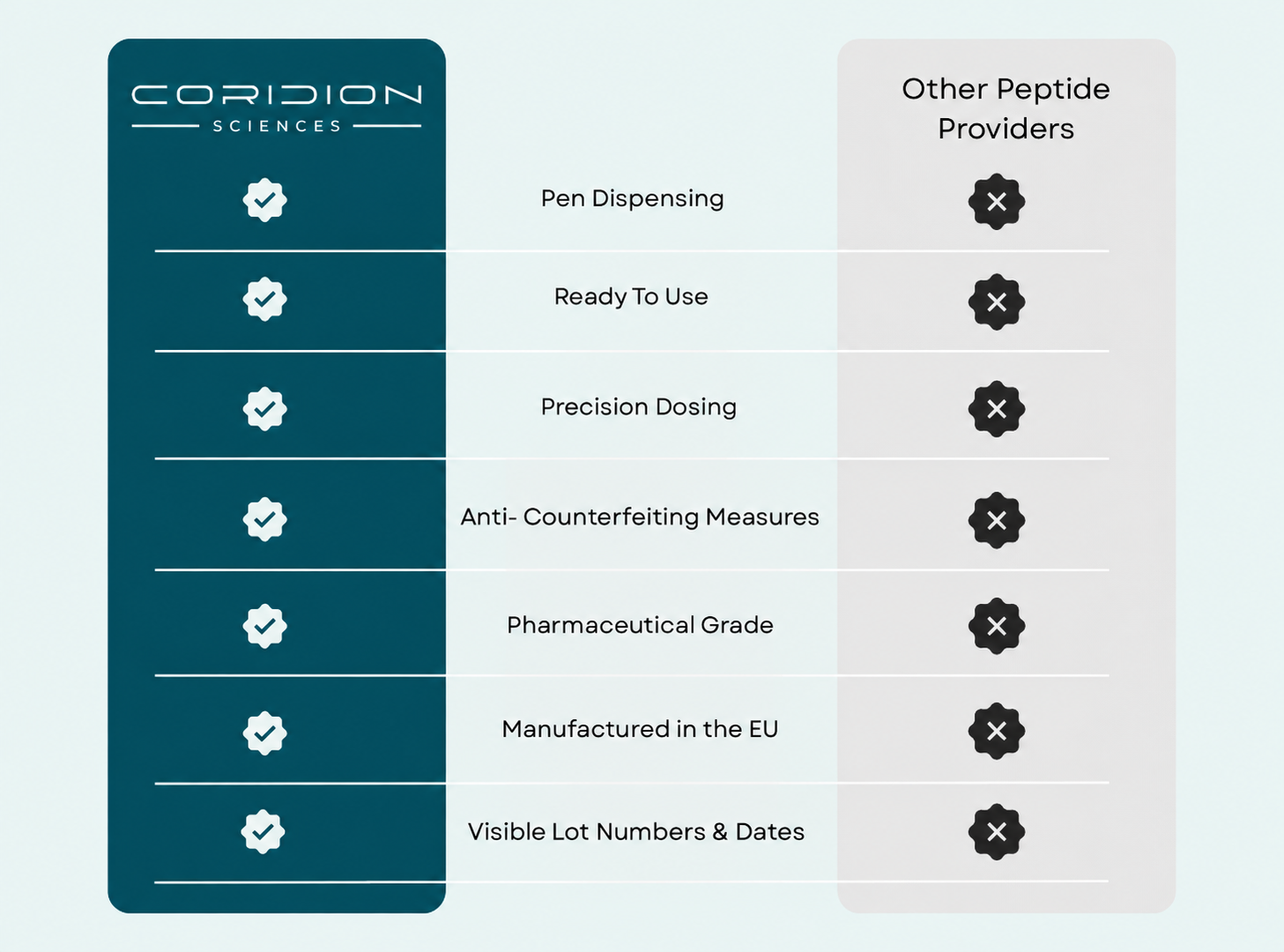
Pre-filled Cartridges
Engineered for absolute accuracy and ease. Our pre-blended pens make precise dosing completely seamless in just three quick steps.
Step 1 - Remove the Pre-mixed pen from the box
Step 2 - Secure the needle tip
Step 3 - Twist to set the required dose
Blends
Blends

Sermorelin + GHRP-6 – 5mg / 5mg (3ml Pen)
Sermorelin + GHRP-6 5mg/5mg combines a 29-amino-acid GHRH analogue with a synthetic ghrelin receptor agonist. Investigated for complementary growth hormone signalling pathways, pituitary hormone. Research use only.
£95.00
Blends

Sermorelin + GHRP-2 – 5mg / 5mg (3ml Pen)
Sermorelin + GHRP-2 5mg/5mg combines a 29-amino-acid GHRH analogue with a synthetic growth hormone secretagogue. Investigated for complementary pituitary signalling, ghrelin receptor activation and. Research use only.
£99.00
Blends

Longevity Blend (Glutathione / NAD+ / Resveratrol) – 500mg / 100mg / 500mg (3ml Pen)
Three pillars of cellular ageing research in one pen. Pairs antioxidant defence, NAD+ coenzyme power, and sirtuin-modulating activity. Research use only. Research use only.
£129.00
Blends

Vitality Blend (Glutathione / NMN / Resveratrol) – 500mg / 500mg / 500mg (3ml Pen)
The NAD+ precursor evolution. Swaps direct NAD+ for NMN — the biosynthetic precursor the cell uses via the salvage pathway. Research use only. Research use only.
£129.00
Blends

SS-31 + MOTS-c – 10mg / 10mg (3ml Pen)
Two mitochondrial compounds acting on different layers of the same biology — membrane structure and mitokine signalling. Research use only. Research use only.
£139.00
Blends

SS-31 + MOTS-c + NAD+ – 10mg / 10mg / 200mg (3ml Pen)
The flagship triple combination of mitochondrial research. SS-31, MOTS-c and NAD+ each act on a different layer of cellular energy biology — structure, signal. Research use only.
£159.00
Blends

KLOW Blend Peptide – BPC-157, TB-500, KPV & GHK-Cu (3ml Pen)
KLOW Blend Peptide combines BPC-157 10mg, TB-500 10mg, KPV 10mg and GHK-Cu 50mg in a four-component research formulation. The blend brings together compounds studied. Research use only.
£105.00
Blends

CJC-1295 (No DAC) + Ipamorelin + GHRP-2 – 3mg / 3mg / 3mg (3ml Pen)
A three-component preparation pairing a GHRH analogue with both a selective and a higher-potency ghrelin agonist. Research use only. Research use only.
£95.00
Blends

Glow Blend Peptide – BPC-157, TB-500 & GHK-Cu (3ml Pen)
Glow Blend Peptide combines GHK-Cu 50mg, BPC-157 10mg and TB-500 10mg in a three-component research formulation. Its ingredients have been investigated individually for extracellular. Research use only.
£95.00