
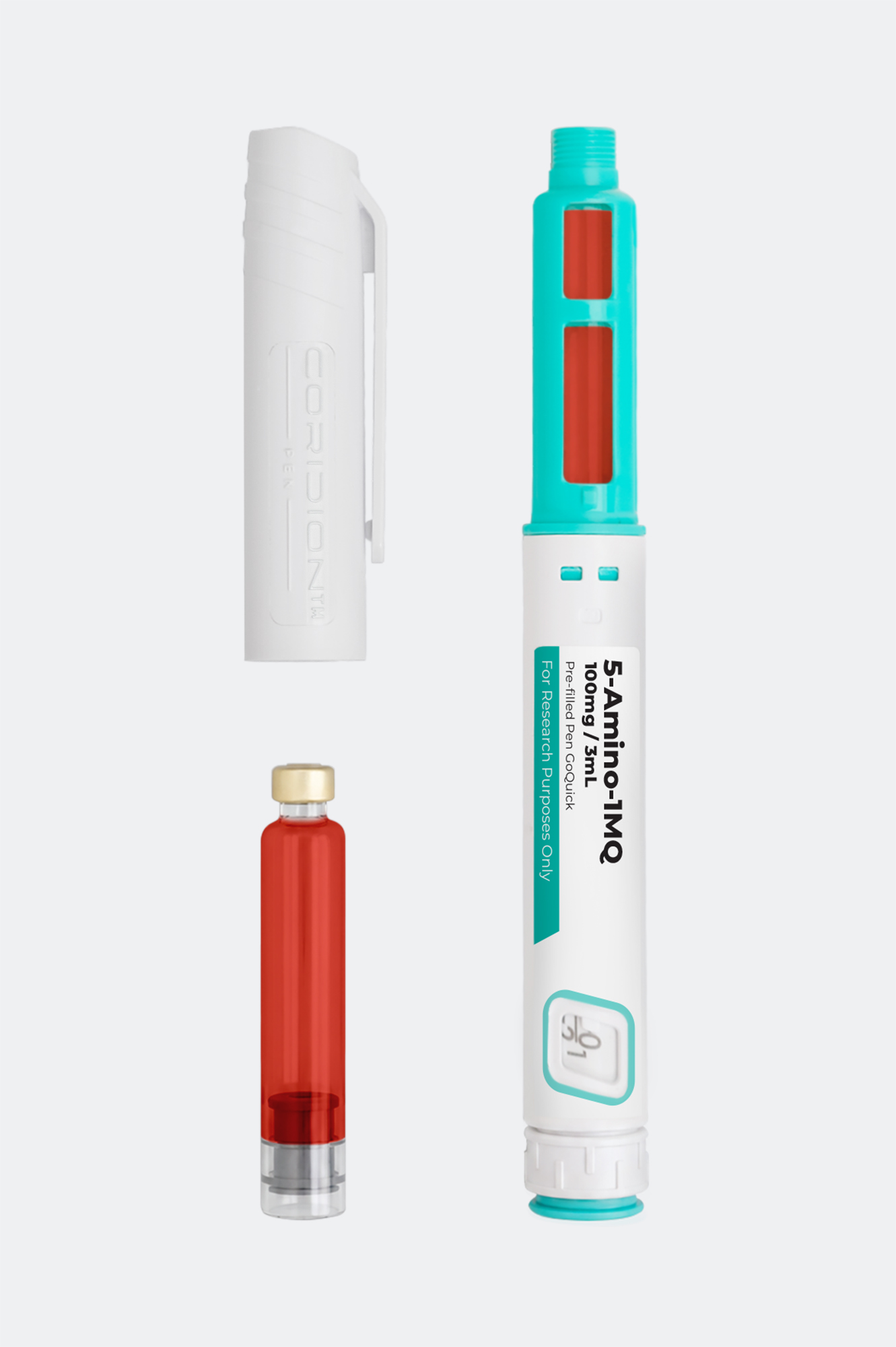
5-Amino-1MQ 100mg (3ml Pen) – NNMT Inhibitor for Metabolic Research
A small-molecule NNMT inhibitor studied for its effect on the NAD+ salvage pathway and adipocyte metabolism. Research use only.
NAD+ Pathway
Metabolic Regulation
Cellular Energy
Description
5-Amino-1MQ is an experimental small-molecule compound investigated for its inhibition of nicotinamide N-methyltransferase (NNMT), an enzyme involved in nicotinamide metabolism, cellular methylation and the regulation of NAD+ availability.
Unlike GLP-1 receptor agonists and hormone-derived metabolic peptides, 5-Amino-1MQ acts through a different research pathway: inhibiting an enzyme that converts nicotinamide into 1-methylnicotinamide.
This mechanism has attracted scientific interest in adipocyte biology, lipid metabolism, methylation-associated signalling and cellular energy regulation.
Published laboratory and animal studies have investigated how NNMT inhibition influences metabolic pathways and selected outcomes in experimental obesity models.
However, 5-Amino-1MQ remains a preclinical research compound. Its safety, effectiveness and pharmacological behaviour in humans have not been established.
Coridion Sciences supplies 5-Amino-1MQ 100mg in a 3ml pen format for scientific and laboratory investigation.
What Is 5-Amino-1MQ?
5-Amino-1MQ, also known as 5-amino-1-methylquinolinium, is a synthetic small-molecule inhibitor of the enzyme nicotinamide N-methyltransferase.
NNMT participates in nicotinamide metabolism by transferring a methyl group from S-adenosylmethionine (SAM) to nicotinamide.
This reaction produces 1-methylnicotinamide (1-MNA) and S-adenosylhomocysteine (SAH).
Because nicotinamide is also used to regenerate nicotinamide adenine dinucleotide (NAD+), NNMT activity connects two important biological processes:
- NAD+ metabolism: The recycling and availability of nicotinamide for cellular metabolic pathways.
- Methylation metabolism: The use of SAM as a methyl-group donor in biochemical reactions.
Researchers have investigated whether inhibiting NNMT changes the distribution of these metabolites and influences selected metabolic functions.
5-Amino-1MQ is particularly relevant because it is a membrane-permeable compound that has demonstrated NNMT inhibition in laboratory experimental systems.
It should not be classified as a peptide, GLP-1 receptor agonist or NAD+ precursor.
5-Amino-1MQ and NNMT Research
Nicotinamide N-methyltransferase is a cytosolic enzyme expressed in several tissues.
Its biological role has been investigated in relation to metabolism, methylation balance and the production of 1-methylnicotinamide.
Changes in NNMT expression have been observed in certain metabolic research models, including investigations involving adipose tissue.
These findings prompted researchers to investigate selective NNMT inhibitors as laboratory tools for understanding the relationship between nicotinamide metabolism and metabolic regulation.
5-Amino-1MQ has been studied in several areas:
- NNMT enzyme inhibition: Investigating how blocking NNMT changes metabolic reactions.
- NAD+ salvage: Examining the availability of nicotinamide for NAD+ regeneration.
- Adipocyte metabolism: Studying lipid accumulation and cellular metabolic responses.
- Methylation-associated pathways: Investigating changes in SAM and 1-MNA concentrations.
- Metabolic research models: Examining selected outcomes in laboratory animals.
- Small-molecule pharmacology: Exploring enzyme selectivity, membrane permeability and structure–activity relationships.
These findings contribute to the scientific understanding of NNMT but do not demonstrate that 5-Amino-1MQ is effective for human weight management.
Researchers examining related pathways can explore our body composition and metabolic research collection.
How Does 5-Amino-1MQ Work?
NNMT Enzyme Inhibition
NNMT catalyses the methylation of nicotinamide using SAM as the methyl-group donor.
The reaction generates 1-MNA and SAH.
5-Amino-1MQ has been investigated as an inhibitor of this enzymatic reaction.
In laboratory studies, researchers have reported reduced production of 1-MNA following exposure to 5-Amino-1MQ.
Because 1-MNA is a direct product of NNMT activity, measuring its formation is one method used to investigate inhibitor activity.
The extent of enzyme inhibition depends on experimental concentration, cellular conditions and the specific assay employed.
NAD+ Salvage Pathway
NAD+ is an essential coenzyme involved in cellular energy metabolism and numerous biochemical reactions.
Nicotinamide can be recycled into NAD+ through the salvage pathway, which includes enzymes such as nicotinamide phosphoribosyltransferase (NAMPT).
NNMT competes for a portion of the available nicotinamide pool by converting nicotinamide into 1-MNA.
By inhibiting this reaction, 5-Amino-1MQ has been investigated for its potential to alter the balance between nicotinamide methylation and NAD+ salvage.
A published study reported increased intracellular NAD+ concentrations under selected conditions in adipocyte experiments.
However, these results do not establish that the compound reliably increases NAD+ in humans or improves human cellular energy production.
For related biochemical research, explore our cellular energy research collection, featuring compounds associated with mitochondrial function, energy metabolism and NAD+-related pathways.
SAM and Cellular Methylation
S-adenosylmethionine (SAM) is an important methyl-group donor involved in numerous cellular reactions.
Because NNMT uses SAM, changes in NNMT activity can influence aspects of cellular methylation metabolism.
Preclinical experiments involving NNMT inhibitors have reported changes in intracellular SAM concentrations.
These findings are relevant to understanding metabolic regulation, but the broader consequences of sustained NNMT inhibition remain incompletely characterised.
Inhibiting NNMT should not automatically be assumed to improve cellular methylation or overall metabolic health.
Adipocyte Lipid Metabolism
Adipocytes are specialised cells involved in storing and regulating lipid reserves.
Their biological activity depends on complex interactions between nutrient availability, signalling pathways and intracellular metabolic processes.
Research involving 5-Amino-1MQ has investigated changes in lipid-related metabolism within cultured adipocytes.
Some laboratory studies have reported reduced lipogenesis-associated measurements following NNMT inhibition.
Such findings are relevant to cellular research but do not establish that the compound reduces body fat in humans.
Scientific Research Applications
1. Adipocyte Metabolism Research
One of the principal research applications of 5-Amino-1MQ involves investigating metabolic responses in adipocytes.
The compound has been used to examine changes in cellular 1-MNA, NAD+ and SAM concentrations.
These studies provide mechanistic information about the relationship between NNMT activity and adipocyte metabolism.
2. Experimental Obesity Models
A 2018 study published in Biochemical Pharmacology investigated selective, membrane-permeable NNMT inhibitors in diet-induced obese mice.
The researchers reported reductions in body weight, white adipose tissue mass and adipocyte size following treatment with NNMT inhibitors.
However, these findings were obtained in animals and cannot be interpreted as evidence of clinical effectiveness in humans.
3. NAD+ Metabolism Research
NAD+ participates in metabolic processes involving oxidation-reduction reactions and cellular signalling.
5-Amino-1MQ provides a method for investigating NAD+ metabolism indirectly through NNMT inhibition rather than through direct NAD+ supplementation.
Its mechanism therefore differs fundamentally from NAD+ precursors such as NMN.
4. Methylation Pathway Research
NNMT activity links nicotinamide metabolism with SAM-dependent methylation.
5-Amino-1MQ has been investigated for its ability to change selected metabolite concentrations associated with this reaction.
This makes it relevant to laboratory studies exploring biochemical relationships between energy metabolism and methylation.
5. Enzyme Selectivity and Small-Molecule Design
Researchers have investigated the selectivity of 5-Amino-1MQ against NNMT and other methyltransferases.
These studies contribute to understanding how molecular structure influences enzyme inhibition and intracellular activity.
The compound is a research tool rather than an established medicinal treatment.
5-Amino-1MQ Compared with Other Metabolic Research Compounds
5-Amino-1MQ – NNMT Inhibition
5-Amino-1MQ is a small-molecule inhibitor associated with nicotinamide metabolism and methylation-associated pathways.
Its principal research distinction is the inhibition of NNMT rather than direct activation of hormonal appetite receptors.
AICAR – AMPK-Associated Research
AICAR is a nucleoside analogue investigated for its effects on AMP-activated protein kinase (AMPK), an important cellular energy-sensing system.
AICAR and 5-Amino-1MQ influence different molecular targets.
Semaglutide – GLP-1 Receptor Agonism
Semaglutide is a GLP-1 receptor agonist with an extensive clinical research history involving glucose regulation and appetite signalling.
Its mechanism and human evidence base are substantially different from those of experimental NNMT inhibitors.
NAD+ – Cellular Coenzyme Research
NAD+ is an essential cellular coenzyme involved in metabolic reactions and cellular signalling.
Although 5-Amino-1MQ research concerns the availability of nicotinamide for NAD+ salvage, it is not itself an NAD+ supplement or precursor.
The two should not be treated as chemically or pharmacologically equivalent.
5-Amino-1MQ 100mg Product Specifications
- Product: 5-Amino-1MQ
- Chemical name: 5-Amino-1-methylquinolinium
- Quantity: 100mg
- Format: 3ml pen
- Classification: Experimental small-molecule enzyme inhibitor
- Primary molecular target: Nicotinamide N-methyltransferase (NNMT)
- Associated pathways: Nicotinamide metabolism, NAD+ salvage and SAM-dependent methylation
- Research focus: NNMT inhibition and adipocyte metabolism
- Additional research areas: Intracellular 1-MNA regulation, metabolic biochemistry and small-molecule pharmacology
- Evidence status: Preclinical; human safety and efficacy have not been established
Metabolic Research at Coridion Sciences
Coridion Sciences supplies specialist experimental compounds and research formulations covering metabolic signalling, cellular energy regulation and biochemical investigation.
5-Amino-1MQ forms part of the company’s broader collection of metabolic research compounds.
Unlike incretin receptor agonists and hormone-derived peptides, its distinctive mechanism concerns the regulation of nicotinamide metabolism through NNMT inhibition.
Researchers can explore the wider Body Composition and Cellular Energy collections for compounds with different metabolic research profiles.
Research Use Only: 5-Amino-1MQ is an experimental small molecule intended exclusively for scientific and laboratory research. It is not approved for human consumption, weight management, obesity treatment or other therapeutic applications. Human pharmacokinetics, long-term safety and clinical effectiveness have not been established.
Mechanisms of Action
5-Amino-1MQ is a small-molecule inhibitor of nicotinamide N-methyltransferase. NNMT methylates nicotinamide, diverting it away from the NAD+ salvage pathway and consuming S-adenosylmethionine in the process. Research reports that inhibiting the enzyme increases intracellular nicotinamide availability for NAD+ regeneration while reducing 1-methylnicotinamide output. Studies in adipocyte models describe associated changes in lipogenesis and cellular energy handling. The compound is not a peptide and its pharmacology is distinct from the NAD+ precursors it is often grouped with.
Research Status & Findings
A narrow preclinical literature centred on adipocyte and rodent models, with mechanistic work on NNMT inhibition considerably better developed than any outcome data.
Enzyme inhibition
Characterisation of NNMT binding and selectivity in cell-free and cellular systems.
Adipocyte research
Studies on lipogenesis and energy handling in fat cell models.
NAD+ salvage
Research on nicotinamide availability and intracellular NAD+ pool changes.
Rodent models
Preclinical work on body composition and metabolic markers in diet-induced obesity models.
Evidence maturity
No clinical trial data; human characterisation is absent.
*For research purposes only – not for human consumption*

As Seen In The Press
Peptides can affect the way the body functions at a cellular level.

Our 3 Step System
Pre-filled Cartridges
Engineered for absolute accuracy and ease. Our pre-blended pens make precise dosing completely seamless in just three quick steps.
Step 1 - Remove the Pre-mixed pen from the box
Step 2 - Secure the needle tip
Step 3 - Twist to set the required dose

Blends
Blends

Sermorelin + GHRP-6 – 5mg / 5mg (3ml Pen)
Sermorelin + GHRP-6 5mg/5mg combines a 29-amino-acid GHRH analogue with a synthetic ghrelin receptor agonist. Investigated for complementary growth hormone signalling pathways, pituitary hormone. Research use only.
£95.00
Blends
Sermorelin + GHRP-2 – 5mg / 5mg (3ml Pen)
Sermorelin + GHRP-2 5mg/5mg combines a 29-amino-acid GHRH analogue with a synthetic growth hormone secretagogue. Investigated for complementary pituitary signalling, ghrelin receptor activation and. Research use only.
£99.00
Blends
Longevity Blend (Glutathione / NAD+ / Resveratrol) – 500mg / 100mg / 500mg (3ml Pen)
Three pillars of cellular ageing research in one pen. Pairs antioxidant defence, NAD+ coenzyme power, and sirtuin-modulating activity. Research use only. Research use only.
£129.00
Blends
Vitality Blend (Glutathione / NMN / Resveratrol) – 500mg / 500mg / 500mg (3ml Pen)
The NAD+ precursor evolution. Swaps direct NAD+ for NMN — the biosynthetic precursor the cell uses via the salvage pathway. Research use only. Research use only.
£129.00
Blends
SS-31 + MOTS-c – 10mg / 10mg (3ml Pen)
Two mitochondrial compounds acting on different layers of the same biology — membrane structure and mitokine signalling. Research use only. Research use only.
£139.00
Blends
SS-31 + MOTS-c + NAD+ – 10mg / 10mg / 200mg (3ml Pen)
The flagship triple combination of mitochondrial research. SS-31, MOTS-c and NAD+ each act on a different layer of cellular energy biology — structure, signal. Research use only.
£159.00
Blends
KLOW Blend Peptide – BPC-157, TB-500, KPV & GHK-Cu (3ml Pen)
KLOW Blend Peptide combines BPC-157 10mg, TB-500 10mg, KPV 10mg and GHK-Cu 50mg in a four-component research formulation. The blend brings together compounds studied. Research use only.
£105.00
Blends
CJC-1295 (No DAC) + Ipamorelin + GHRP-2 – 3mg / 3mg / 3mg (3ml Pen)
A three-component preparation pairing a GHRH analogue with both a selective and a higher-potency ghrelin agonist. Research use only. Research use only.
£95.00
Blends
Glow Blend Peptide – BPC-157, TB-500 & GHK-Cu (3ml Pen)
Glow Blend Peptide combines GHK-Cu 50mg, BPC-157 10mg and TB-500 10mg in a three-component research formulation. Its ingredients have been investigated individually for extracellular. Research use only.
£95.00


